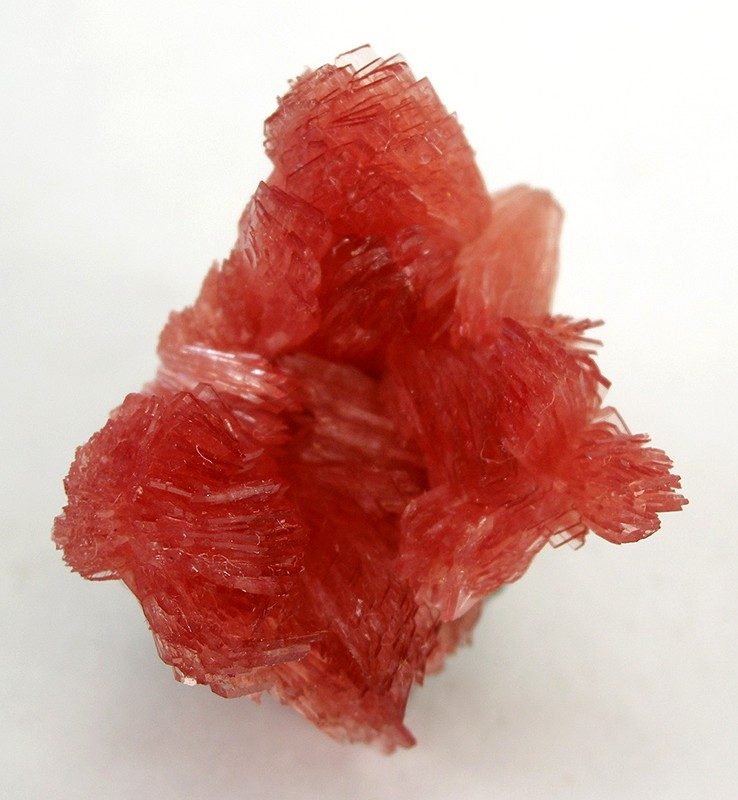
Inesite Locality: Wessels Mine (Wessel's Mine), Hotazel, Kalahari manganese fields, Northern Cape Province , South Africa ( Locality at mindat.org ) Size: thumbnail, 3 x 2.5 x 2 cm Inesite This is a cherry-red, lustrous, somewhat gemmy inesite from the famous early 1980s pocket that yielded the best quality of inesite found at these mines. Today, the pieces from this pocket are recognizably more lustrous and red than from other finds, and carry a premium. This is a super thumbnail example from the find! — Photo: Robert M. Lavinsky · CC BY-SA 3.0
Inesite
A hydrated calcium-manganese inosilicate forming handsome rose-pink triclinic crystals.
Intro adapted from Wikipedia (CC BY-SA).
Inesite is an IMA-recognized mineral species in the silicate class, with the chemical formula Ca₂Mn²⁺₇Si₁₀O₂₈(OH)₂·5H₂O.
It crystallizes in the triclinic crystal system (space group P1).
Key properties: Mohs hardness 5.5–6; specific gravity 3.03–3.04; White streak; Vitreous to silky luster; optically biaxial.
IMA symbol Ins, grandfathered status — known before the IMA’s founding, named in 1887.
A late-stage hydrothermal mineral in manganese deposits.
It is found associated with Rhodochrosite, bementite, hausmannite (Hale Creek mine, California, USA); datolite, pectolite, apophyllite, ruizite, orientite, quartz (Wessels mine.
Its name comes from the Greek for flesh fibers, in allusion to its color and structure.