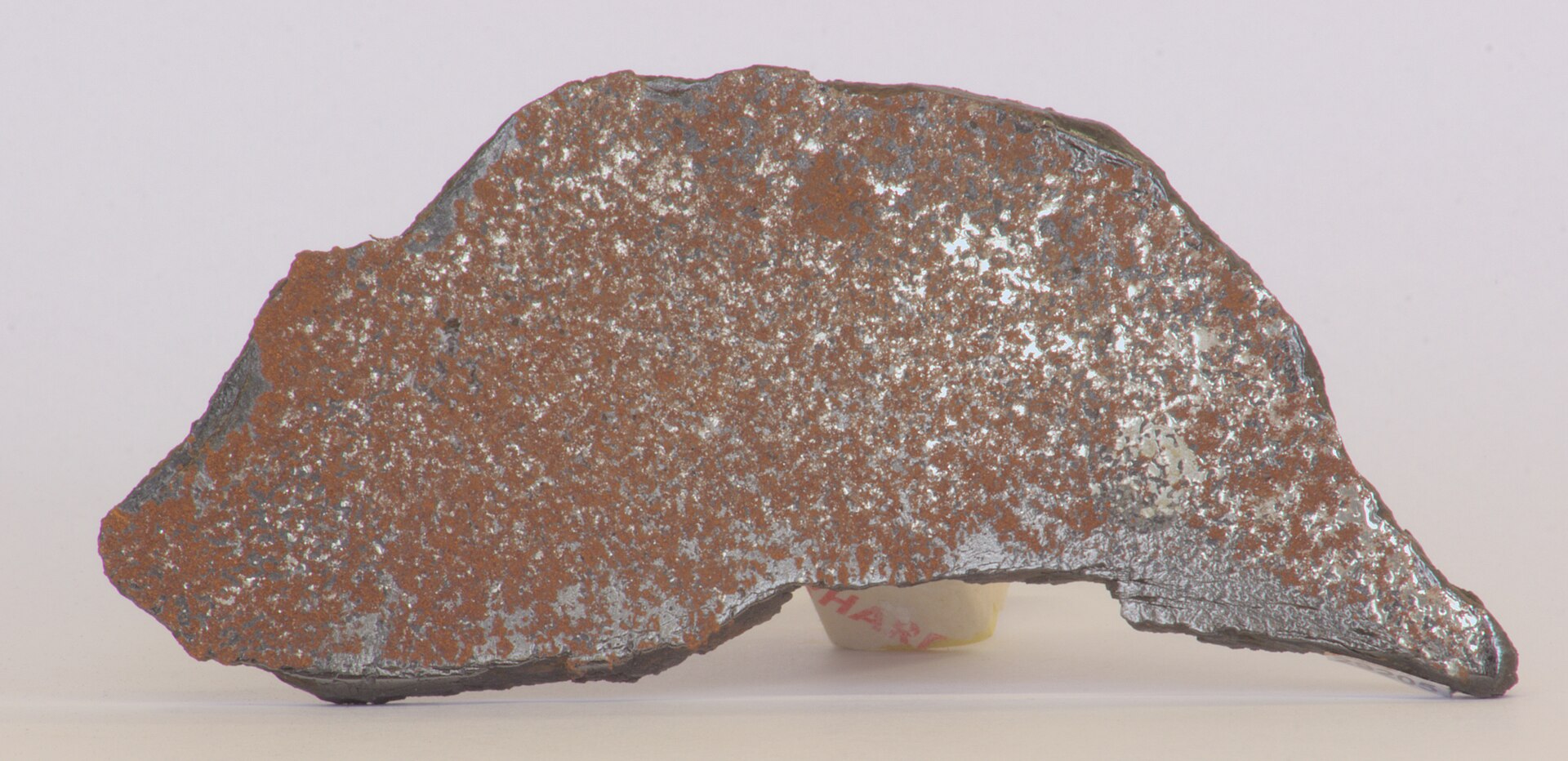
Iron from Ozernaya mountain, Nizhnaya Tunguska, Siberia, Russia — Photo: Slashme · CC BY 4.0
Iron
Also known as: Native iron, Kamacite (meteoritic).
The most common element on Earth by mass (symbol Fe, atomic number 26) — core of the planet, backbone of industry, and a native mineral in meteorites and basalts.
Intro adapted from Wikipedia (CC BY-SA).
Iron is an IMA-recognized mineral species in the native element class, with the chemical formula Fe.
It crystallizes in the cubic crystal system (space group Im3m). It is a member of the Iron structural group.
Key properties: Mohs hardness 4; specific gravity 7.3–7.87; typically gray or black; gray streak; Metallic. R: (400) 56.8, (420) 57.2, (440) 57.6, (460) 57.8, (480) 57.9, (500) 58.0, (520) 58.1, (540) 58.1 luster.
IMA symbol Fe, grandfathered status — known before the IMA’s founding.
Rare in igneous rocks, especially basalts; in carbonaceous sediments; in volcanic fumaroles; and in petrified wood, mixed with “limonite” and organic matter.
It is found associated with Pyrite, magnetite, troilite, wüstite, cohenite.
An Old English word for the metal; the chemical symbol from the Latin ferrum.
Collections: Metals & Native Elements, Rare & Remarkable.