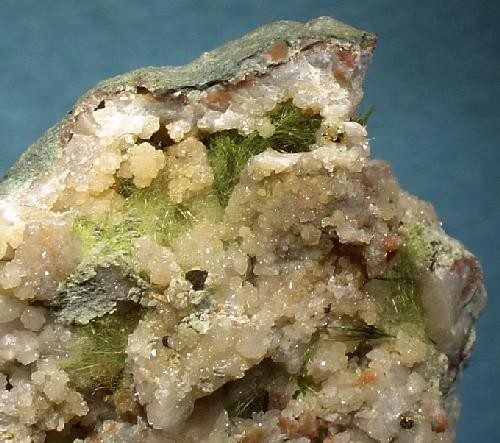
Jamborite Locality: Halls Gap , Lincoln County, Kentucky , USA ( Locality at mindat.org ) Size: 4.1 x 3.5 x 2.9 cm. Jamborite is an ULTRA RARE alteration product of millerite, found in few localities worldwide. This showy and excellent geode has several vugs lined with yellow-green jamborite needles in pleasing association with quartz and dolomite. The richest and best vug is 9 mm across. Jamborite is a pseudomorph of millerite. VERY RARE! Ex. Carlton Davis collection. — Photo: Robert M. Lavinsky · CC BY-SA 3.0
Jamborite
A green hexagonal nickel-cobalt hydroxide-sulfide first published in 1973.
Intro adapted from Wikipedia (CC BY-SA).
Jamborite is an IMA-recognized mineral species in the sulfate class, with the chemical formula Ni²⁺₁₋ₓCo³⁺ₓ(OH)₂₋ₓ(SO₄)ₓ·nH₂O [x ≤ 1/3 n; ≤ (1-x)].
It crystallizes in the hexagonal crystal system (space group R-3m). It is a member of the Hydrotalcite structural group.
Key properties: specific gravity 2.67; optically uniaxial.
IMA symbol Jbr, IMA status: approved, named in 1971.
Found in small cavities in ophiolitic rocks (Italy); in serpentinites (Shinshiro, Japan).
It is found associated with Millerite, calcite, dolomite, quartz (Italy); gaspéite, glaukosphaerite, mcguinnessite (Shinshiro, Japan).
The mineral was named to honor John Leslie Jambor (1936–), Canadian mineralogist with the Geological Survey of Canada.