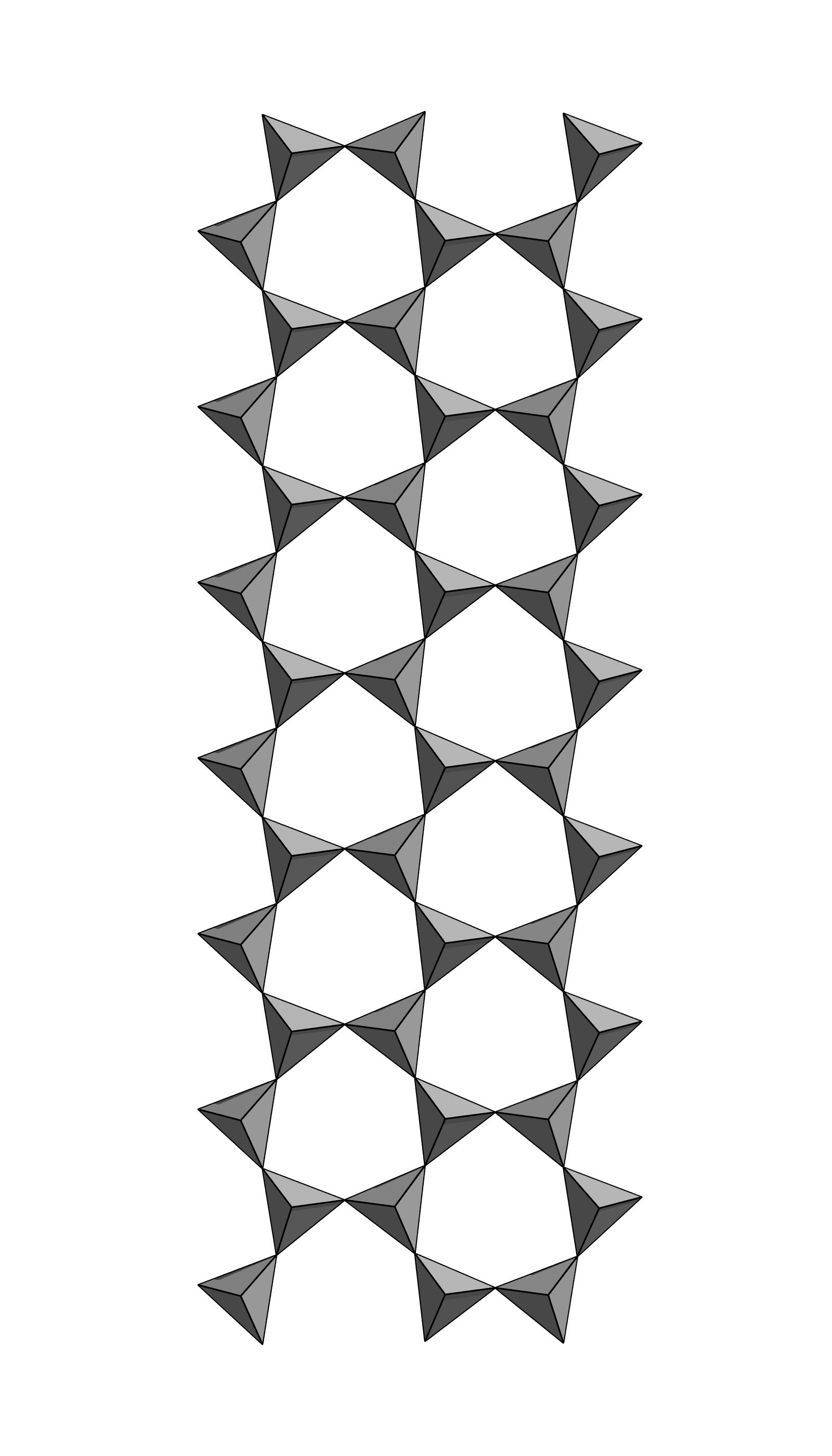
Unbranched zweier triple chain of Jimthompsonite Data from: Veblen, D. R.; Burnham, C. W. (1978): New biopyriboles from Chester, Vermont: II. The crystal chemistry of jimthompsonite, clinojimthompsonite, and chesterite, and the amphibole-mica reaction, American Mineralogist 630, pp. 1053-1073 http://rruff.geo.arizona.edu/AMS/download.php?id=00694.cif&down=cif Calculation of image data: Larry W. Finger, Martin Kroeker, and Brian H. Toby, DRAWxtl, an open-source computer program to produce crystal-structure drawings, J. Applied Crystallography V40, pp. 188-192, 2007 http://www.lwfinger.net/drawxtl/ Rendering: POVRAY — Photo: Bubenik · CC BY-SA 3.0
Jimthompsonite
A magnesium-iron triple-chain silicate — the 'triple-width' cousin of the amphiboles, with clinojimthompsonite and chesterite.
Intro adapted from Wikipedia (CC BY-SA).
Jimthompsonite is an IMA-recognized mineral species in the silicate class, with the chemical formula Mg₅Si₆O₁₆(OH)₂.
It crystallizes in the orthorhombic crystal system (space group Pbca).
Key properties: Mohs hardness 2.25; specific gravity 3.02; refractive index 1.621; optically biaxial.
IMA symbol Jim, IMA status: approved, named in 1977.
Found in the black wallrock between chlorite and actinolite zones of a metamorphosed ultramafic body.
It is found associated with Chesterite, clinojimthompsonite, anthophyllite, cummingtonite, talc.
The name refers to Professor James Burleigh Thompson, Jr. (1921{), eminent petrologist of Harvard University, Cambridge, Massachusetts, USA.