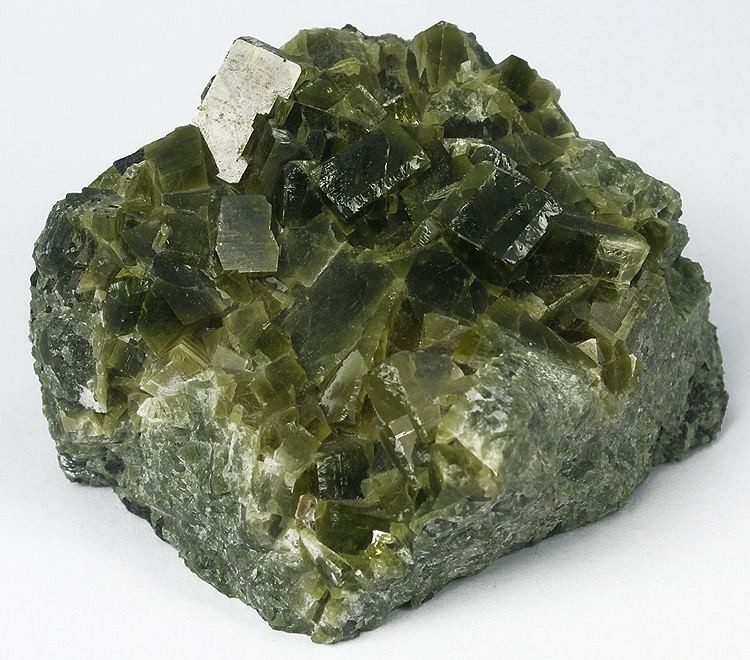
Johannsenite Locality: North Mine (North Broken Hill Mine; NBH Mine), Broken Hill , Yancowinna County, New South Wales , Australia ( Locality at mindat.org ) Size: 5.5 x 4.5 x 3.3 cm. Johannsenite is a rare pyroxene group silicate and this fine, very rich specimen features huge, blocky, highly lustrous, olive-green crystals to 1.2 cm on matrix. This is also a rare and exceptional locality piece from the North Mine at Broken Hill, Australia. Ex. T.M. Phetteplace and Jaime Bird Collections. — Photo: Robert M. Lavinsky · CC BY-SA 3.0
Johannsenite
A calcium-manganese pyroxene of metamorphosed limestones, often associated with lead-zinc mineralization.
Intro adapted from Wikipedia (CC BY-SA).
Johannsenite is an IMA-recognized mineral species in the silicate class, with the chemical formula CaMnSi₂O₆.
It crystallizes in the monoclinic crystal system (space group C2/c). It is a member of the Pyroxene structural group.
Key properties: Mohs hardness 6; specific gravity 3.27–3.54; optically biaxial.
IMA symbol Jhn, IMA status: approved, named in 1938.
Found in metasomatized limestones and manganiferous skarns; in quartz or calcite veins cutting rhyolite.
It is found associated with Rhodonite, manganese oxides.
The mineral was named to honor Professor Albert Johannsen (1871–1962), petrologist, University of Chicago, Chicago, Illinois, USA.