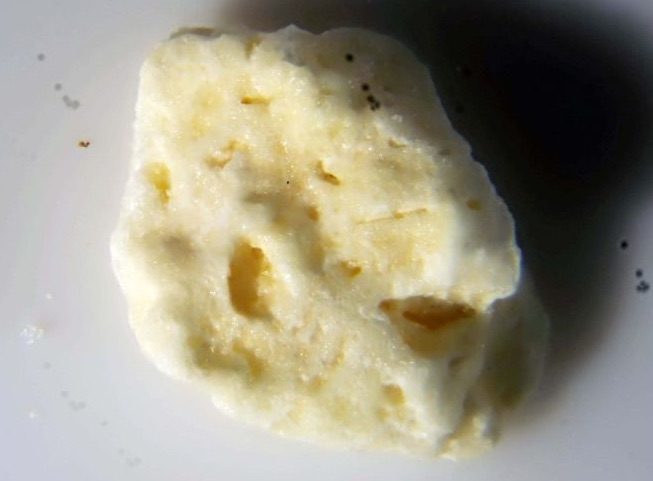
A small pale yellow specimen of the very rare Mn sulfate mineral jôkokuite from the type locality in Jokoku mine, Japan (Johkoku Mine, Kaminokuni, Hiyama District, Hiyama Subprefecture, Hokkaidō Prefecture, Hokkaido Island, Japan). Ex Vandenbroucke Museum collection from Waregem, Belgium. — Photo: David Hospital · CC BY-SA 4.0
Jôkokuite
A triclinic manganese sulfate pentahydrate discovered in 1976 at Hokkaido's Jokoku mine.
Intro adapted from Wikipedia (CC BY-SA).
Jôkokuite is an IMA-recognized mineral species in the sulfate class, with the chemical formula Mn²⁺(SO₄)·5H₂O.
It crystallizes in the triclinic crystal system (space group P-1). It is a member of the Chalcanthite structural group.
Key properties: Mohs hardness 2.5; specific gravity 2.03; White streak; Vitreous luster; optically biaxial.
IMA symbol Jôk, IMA status: approved, named in 1976.
Occurs as efflorescences in oxidized portions of mine workings, apparently deposited from mine waters at 25 ° C.
It is found associated with Gypsum, szmikite, ilesite, rozenite, siderotil, ferrohexahydrite, mallardite, melanterite, goslarite (Jokoku mine, Japan).
The name refers to the Jokoku mine, Japan, where the first specimens were collected.