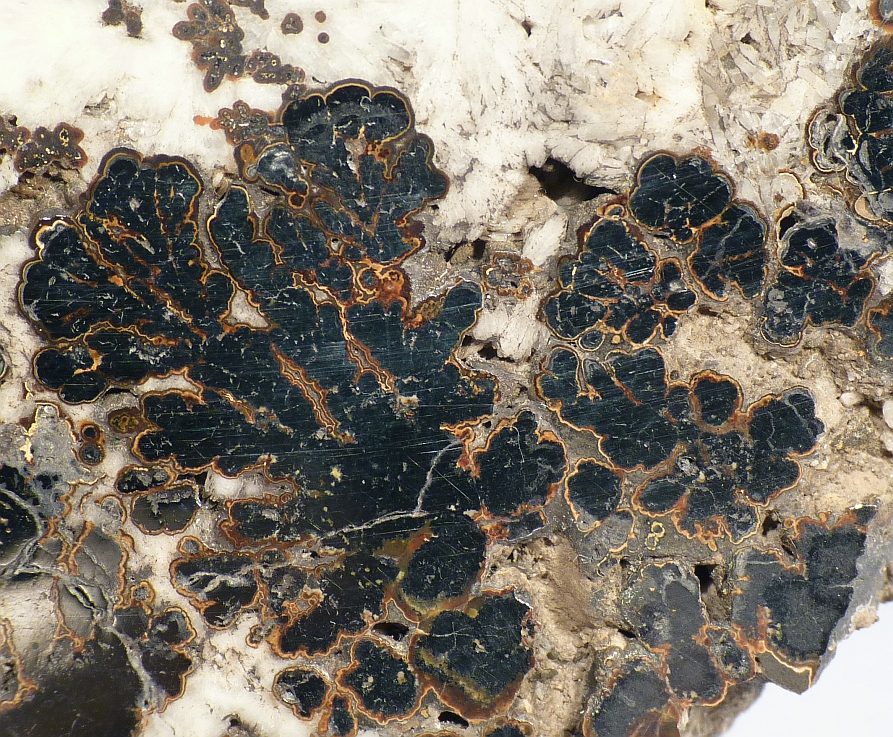
Jordanite Locality: Segen Gottes Mine, Wiesloch, Baden-Württemberg, Germany Gray metallic jordanite in schalenblende. Field of view 2.5 cm. Specimen and photo Leon Hupperichs. — Photo: Leon Hupperichs · CC BY-SA 3.0
Jordanite
A monoclinic lead-arsenic sulfosalt named for Hermann Jordan, who discovered it in 1864 — the high-temperature dimorph of gratonite.
Intro adapted from Wikipedia (CC BY-SA).
Jordanite is an IMA-recognized mineral species in the sulfosalt class, with the chemical formula Pb₁₄As₆S₂₃.
It crystallizes in the monoclinic crystal system (space group P2_1/m). It is a member of the Geocronite structural group.
Key properties: Mohs hardness 3; specific gravity 6.44; Black streak; Metallic. R1 –R2: (400) 41.8–44.6, (420) 41.0–43.7, (440) 40.2–42.8, (460) 39.7–42.2, (480) 39.3–41.8, (500) 38.9–41.4 luster.
IMA symbol Jrd, grandfathered status — known before the IMA’s founding, named in 1864.
Found in metamorphosed Pb–As occurrences in dolostone (Binntal, Switzerland); in low-temperature epithermal veins (Aomori Prefecture, Japan); in epithermal gold-quartz veins (Săcărı̂mb, Romania); from “black smoker” undersea chimneys.
It is found associated with Tennantite, seligmannite, dufrenoysite, boulangerite, semseyite, quadratite, guettardite, zinkenite, tsugaruite, kirkiite, enargite, sphalerite, galena.
The mineral was named to honor Dr. H. Jordan (1808–1887), of Saarbrücken, Germany, who provided the original specimens for study.