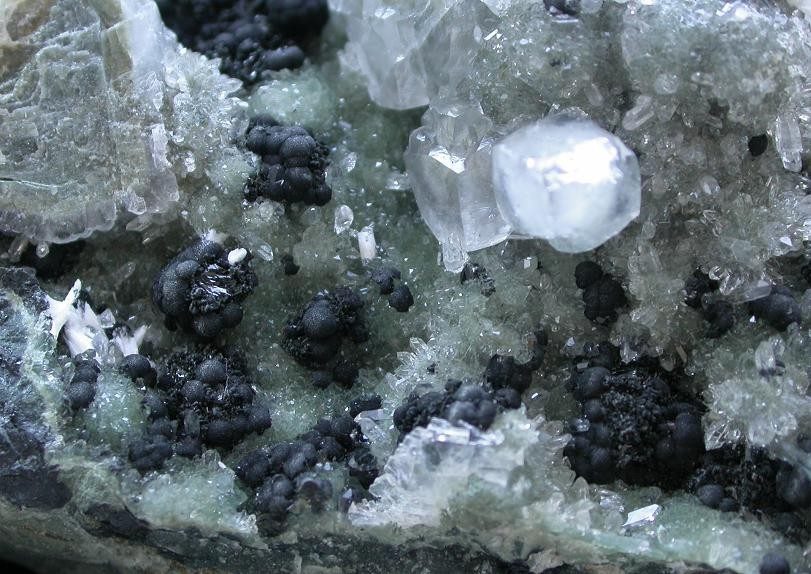
Julgoldite-(Fe2+) Locality: Jalgaon District , Maharashtra , India ( Locality at mindat.org ) Black spheres of Julgoldite-(Fe2+). Field of view 4 cm. Specimen and photo Leon Hupperichs. — Photo: Leon Hupperichs · CC BY-SA 3.0
Julgoldite-(Fe2+)
Julgoldite is a member of the pumpellyite mineral series, a series of minerals characterized by the chemical bonding of silica tetrahedra with alkali and transition metal cations. Julgoldites, along with more common minerals like epidote and vesuvianite, belong to the subclass of sorosilicates, the rock-forming minerals that contain SiO4 tetrahedra that share a common oxygen to form Si2O7 ions with a charge of 6− (Deer et al., 1996).
Intro adapted from Wikipedia (CC BY-SA).
Julgoldite-(Fe2+) is an IMA-recognized mineral species in the silicate class, with the chemical formula Ca₂Fe²⁺Fe³⁺₂(Si₂O₇)(SiO₄)(OH)₂·H₂O.
It crystallizes in the monoclinic crystal system (space group A2/m). It is a member of the Pumpellyite structural group.
Key properties: Mohs hardness 4.5; specific gravity 3.58–3.6; Greenish olive with a bluish tinge streak; Nearly submetallic luster; optically biaxial.
IMA symbol Jul-Fe2+, IMA status: approved, named in 1966.
Found in hematite-magnetite ore (Lº angban, Sweden); in quartz-diabase (Scotland).
It is found associated with Apophyllite, barite, hematite, magnetite, ilvaite, calcite, quartz, chlorite, prehnite, epistilbite, stilbite, pectolite, laumontite, babingtonite, titanite.
The name refers to Professor Julian Royce Goldsmith (1918{), mineralogist and geochemist, University of Chicago, Chicago, Illinois, USA, and its ferrous iron content. All rights reserved.