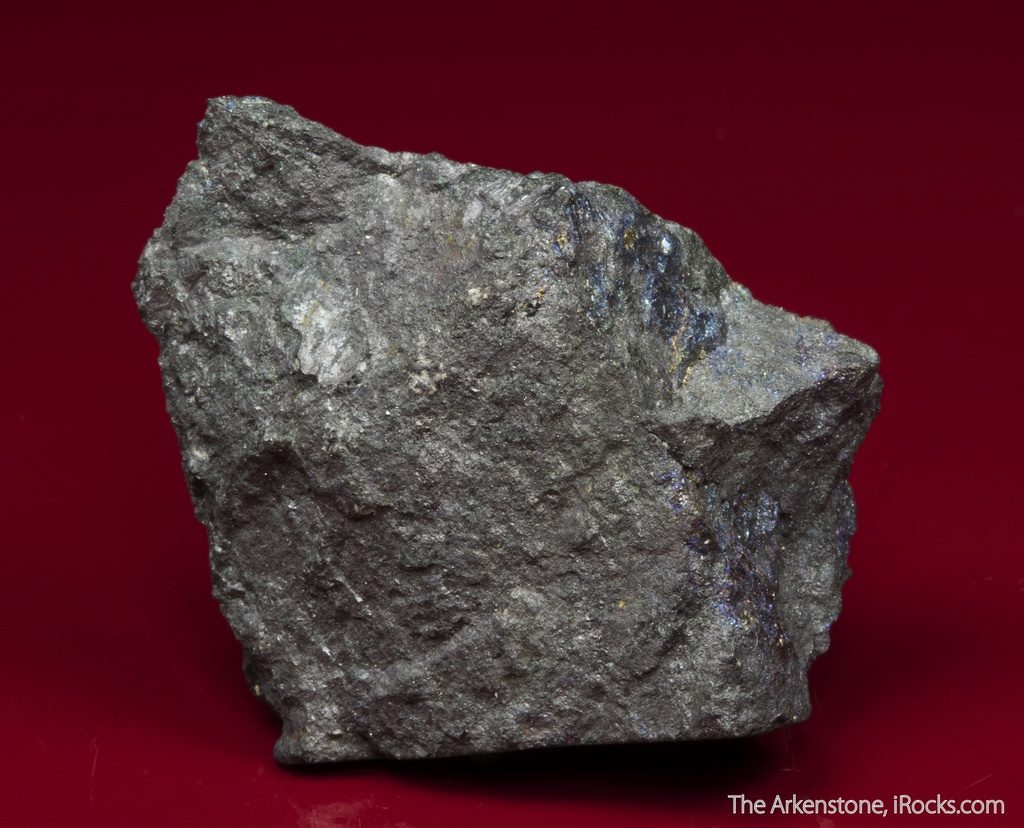
Junoite Dimensions: 3.5 x 2.5 x 1.8 cm Locality: Juno Mine (Peko Mine), Tennant Creek, Barkly Region, Northern Territory, Australia Description: An excellent, rare specimen from the 700 level of the type locality at Tennant Creek, Australia. A gray-black, sub-metallic, mass of junoite is associated with silver-gray proudite, and bornite. The Matioli label also indicates pekoite, bismuthinite, and chalcopyrite. Annotations on a white painted surface on the back of the specimen indicates the mine and the level from which it was obtained. South Australian Museum and Paulo Matioli labels. An acquisition date (or collecting date, from the museum?) of 1971 is noted on the back of the specimen. Photos by Tom and Melissa Campbell. — Photo: Robert M. Lavinsky · CC BY-SA 3.0
Junoite
Junoite is an IMA-recognized mineral species in the sulfosalt class, with the chemical formula Cu₂Pb₃Bi₈(S,Se)₁₆.
It crystallizes in the monoclinic crystal system (space group C2/m).
Key properties: specific gravity 6.77.
IMA symbol Jnt, IMA status: approved, named in 1974.
Hydrothermal in origin.
It is found associated with Gold, selenian heyrovskýite, krupkaite, proudite, chalcopyrite, magnetite (Juno mine, Australia); chalcopyrite, sphalerite, cobaltite, kësterite.
The name refers to the Juno mine, Australia, where it was first found.