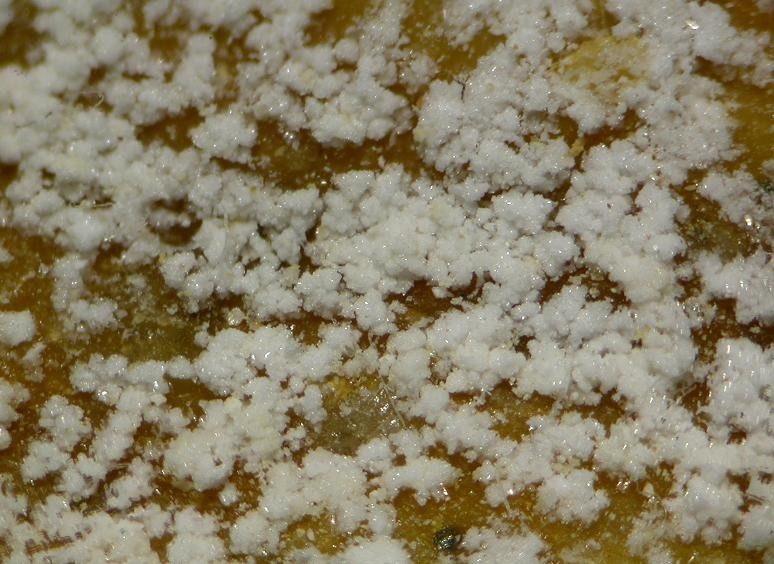
Jurbanite Locality: Le Cetine di Cotorniano Mine (Le Cetine Mine; Cetine Mine; Rosia), Chiusdino, Siena Province, Tuscany, Italy White clusters of Jurbanite crystals. Field of view 5 mm. Specimen and photo Leon Hupperichs. — Photo: Leon Hupperichs · CC BY-SA 3.0
Jurbanite
A monoclinic hydrated aluminium sulfate — the dimorph of orthorhombic rostite.
Intro adapted from Wikipedia (CC BY-SA).
Jurbanite is an IMA-recognized mineral species in the sulfate class, with the chemical formula Al(SO₄)(OH)·5H₂O.
It crystallizes in the monoclinic crystal system (space group P2_1/n).
Key properties: Mohs hardness 2.5; specific gravity 1.786; [Vitreous.] luster; refractive index 1.472; optically biaxial.
IMA symbol Jur, IMA status: approved, named in 1974.
Occurs as rare secondary crusts in humid tunnels in oxidized portions of sulfide deposits in aluminous rocks; apparently deposited directly from mine water at about 27 ° C and 100% humidity (San Manuel mine, Arizona, USA).
It is found associated with Epsomite, hexahydrite, pickeringite, starkeyite (San Manuel mine, Arizona, USA); rostite, gypsum, pickeringite, metavoltine, ferrinatrite, sideronatrite.
The mineral was named to honor Joseph John Urban (1915–1997), Tucson, Arizona, USA, mineral collector who first observed the natural material.