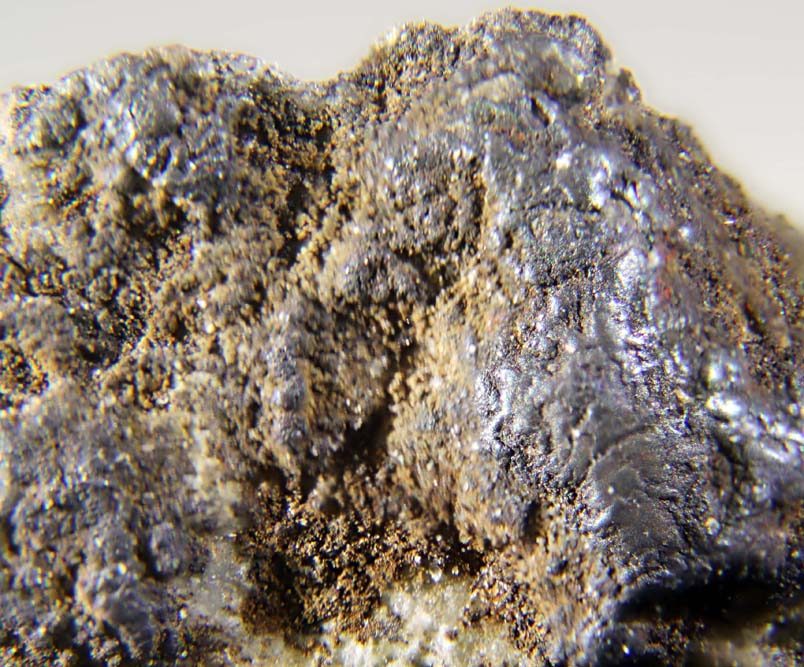
Grey crystal aggregates of the very rare molybdenum mineral kamiokite from Mohawk Mine, Keweenaw, Michigan, United States of America. — Photo: David Hospital · CC BY-SA 4.0
Kamiokite
An iron-molybdenum oxide discovered in 1975 at Japan's Kamioka mine.
Intro adapted from Wikipedia (CC BY-SA).
Kamiokite is an IMA-recognized mineral species in the oxides & hydroxide class, with the chemical formula Fe²⁺₂Mo⁴⁺₃O₈.
It crystallizes in the hexagonal crystal system (space group P6_3mc). It is a member of the Nolanite structural group.
Key properties: Mohs hardness 3–4.5; specific gravity 5.96; Black streak; Metallic to submetallic luster; optically uniaxial.
IMA symbol Kmk, IMA status: approved, named in 1975.
Found in quartz-molybdenite stockwork veins in association with granite porphyry dikes (Japan); in fissure veins filled during low-grade regional metamorphism of basalt (Michigan, USA).
It is found associated with Molybdenite, potassic feldspar, fluorite, ilmenite, scheelite, quartz (Kamioka mine, Japan); domeykite, algodonite, nickeline, maucherite, koutekite.
The name refers to the occurrence at the Kamioka mine, Japan.