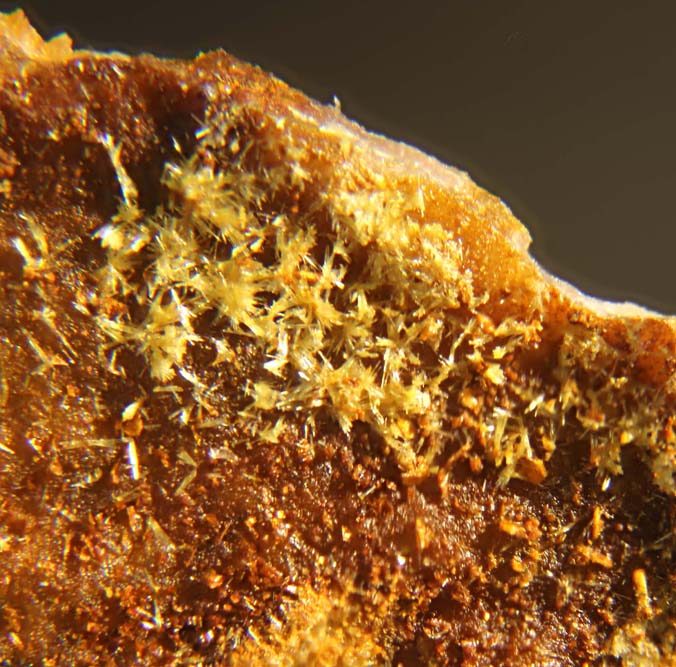
Outstanding yellow crystals of the rare arsenate mineral kaňkite from the type locality in Kaňk, Kutná Hora (Kuttenberg), Bohemia, Czech Republic. — Photo: David Hospital · CC BY-SA 4.0
Kaňkite
A yellowish hydrous ferric arsenate forming on medieval mine dumps at Kaňk, Czech Republic.
Intro adapted from Wikipedia (CC BY-SA).
Kaňkite is an IMA-recognized mineral species in the arsenate class, with the chemical formula Fe³⁺(AsO₄)·3.5H₂O.
It crystallizes in the monoclinic crystal system. It is a member of the Kaňkite structural group.
Key properties: Mohs hardness 2–3; specific gravity 2.6–2.7; Grayish yellow streak; Dull to vitreous luster; optically biaxial.
IMA symbol Kňk, IMA status: approved, named in 1975.
Found as a rare secondary mineral in highly weathered mine dumps containing arsenopyrite (Kaňk, Czech Republic).
It is found associated with Scorodite, pitticite, parascorodite, zýkaite, arsenopyrite, gypsum, “limonite”, quartz (Kaňk, Czech Republic); scorodite, parascorodite, vajdakite, arsenic.
The name is derived from the locality that yielded the first specimens, Kaňk, Czech Republic.