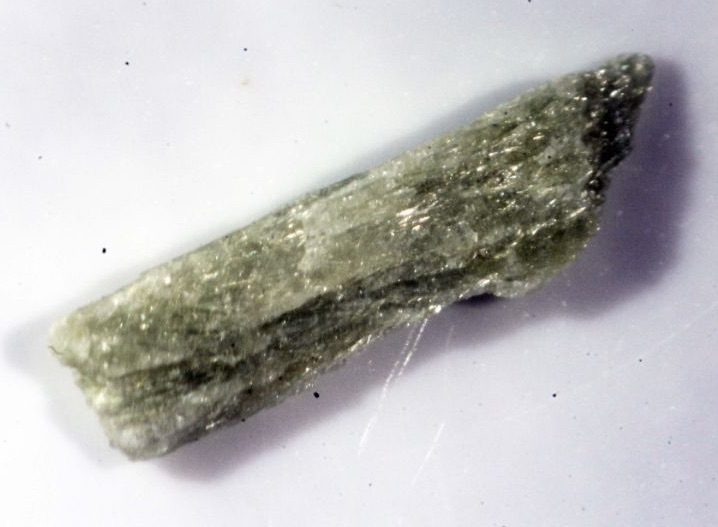
Greenish single group of karlite from Furtschaglkar, Schlegeisgrund, Schwaz District, Tyrol, Austria. Ex Vandenbroucke Museum collection from Waregem, Belgium. — Photo: David Hospital · CC BY-SA 4.0
Karlite
A silky white-to-green magnesium chloroborate named for Kiel mineralogist Franz Karl.
Intro adapted from Wikipedia (CC BY-SA).
Karlite is an IMA-recognized mineral species in the borate class, with the chemical formula (Mg,Al)₆.₅(BO₃)₃(OH)₄( ,Cl)₀.₅.
It crystallizes in the orthorhombic crystal system (space group P2_12_12).
Key properties: Mohs hardness 5.5; specific gravity 2.8–2.85; White streak; Silky luster; refractive index 1.618; optically biaxial.
IMA symbol Ka, IMA status: approved, named in 1980.
Probably formed by Alpine metamorphism, in a calcsilicate–carbonate lens in amphibolites (Schlegeistal, Austria).
It is found associated with Calcite, dolomite, “chlorite”, clinohumite, brucite, ludwigite (Schlegeistal, Austria); sakhaite (Siberia, Russia).
The mineral was named to honor Dr. Franz Karl (1918–1972), Professor of Mineralogy and Petrography, Christian Albrechts University, Kiel, Germany, for his studies of the geology of the eastern Alps.