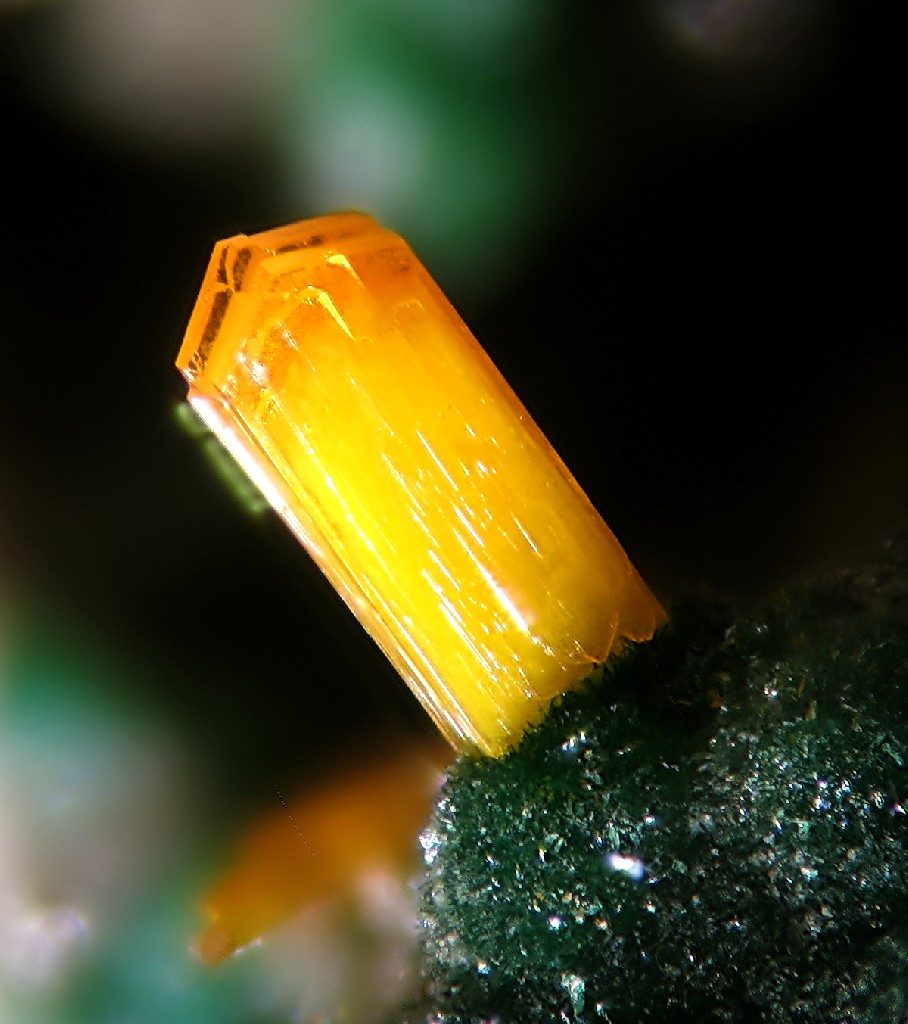
Kasolite Locality: Musonoi Mine, Kolwezi , Western area, Katanga Copper Crescent, Katanga (Shaba) , Democratic Republic of Congo (Zaïre) ( Locality at mindat.org ) Picture width 2 mm. Collection and photograph Christian Rewitzer — Photo: Christian Rewitzer · CC BY-SA 3.0
Kasolite
A yellow lead uranyl silicate — an oxidation-zone uranium mineral described by Schoep in 1921.
Intro adapted from Wikipedia (CC BY-SA).
Kasolite is an IMA-recognized mineral species in the silicate class, with the chemical formula Pb(UO₂)(SiO₄)·H₂O.
It crystallizes in the monoclinic crystal system (space group P2_1/c).
Key properties: Mohs hardness 4–5; specific gravity 5.83–6.5; Pale yellow-brown streak; Subadamantine to greasy, dull to earthy when massive luster; optically biaxial.
IMA symbol Kso, IMA status: approved, named in 1921.
An oxidization product of uraninite.
It is found associated with Uraninite, torbernite, curite, dewindtite (Kasolo, Congo); rutherfordine, sklodowskite, curite (Nabarlek, Australia).
The name refers to the occurrence at Shinkolobwe, near Kasolo Hill, Congo (Zaire).