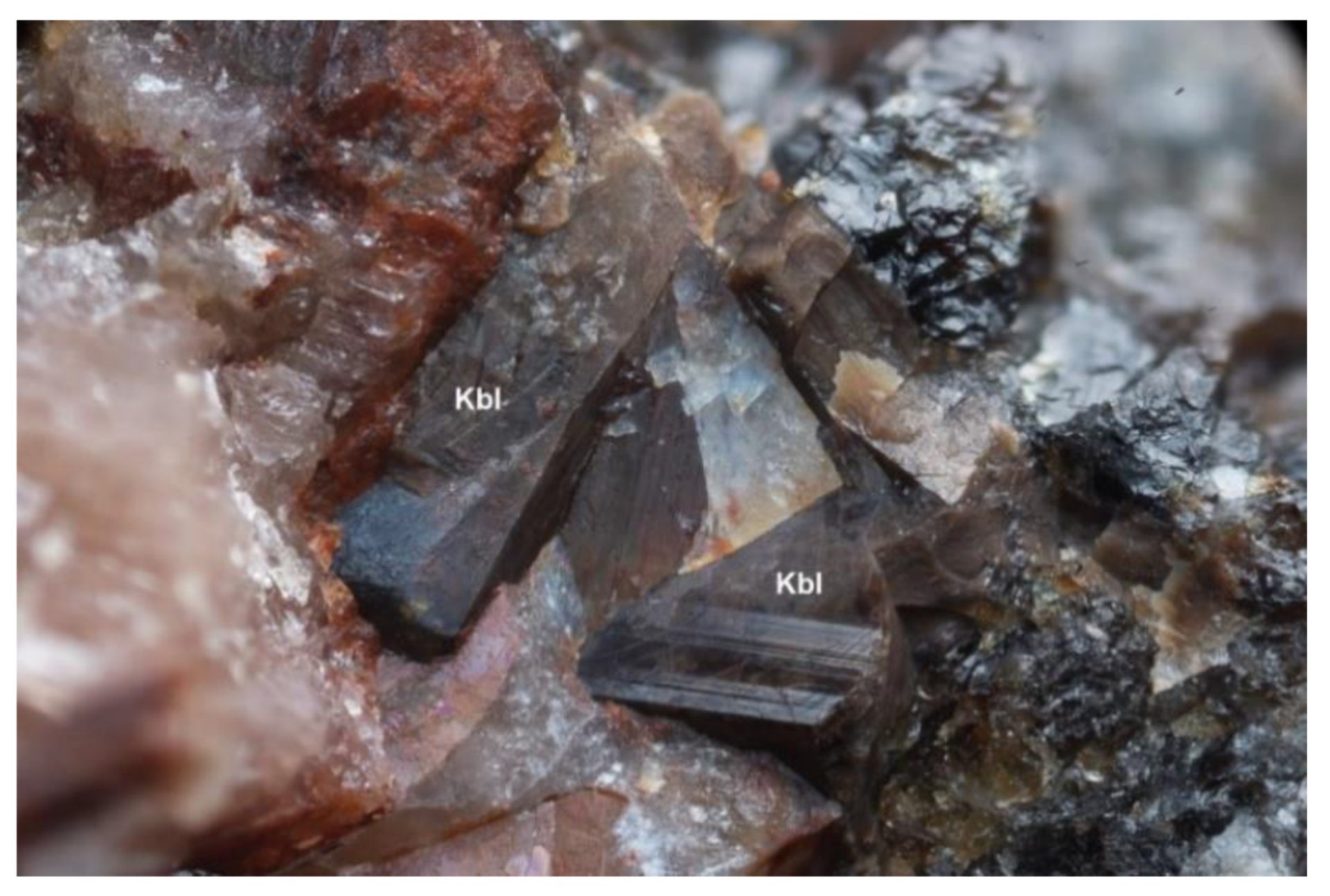
The kesebolite-(Ce) (Kbl) type specimen with calcite (white) and rhodonite (reddish), GEO-NRM No. 20100343. Field of view is ca. 5 × 3 mm. Photo: Torbjörn Lorin. The image is published in an open access article distributed under the terms and conditions of the Creative Commons Attribution (CC BY) license ( https://creativecommons.org/licenses/by/4.0/ ). — Photo: Torbjörn Lorin · CC BY 4.0
Kesebolite-(Ce)
Kesebolite-(Ce) is an IMA-recognized mineral species in the silicate class, with the chemical formula CeCa₂Mn(AsO₄)(SiO₃)₃.
It crystallizes in the monoclinic crystal system (space group P2_1/c).
Key properties: Mohs hardness 5–6; specific gravity 3.998; Light brown streak; Vitreous luster; optically biaxial.
IMA symbol Ksb-Ce, IMA status: approved, named in 2020.
Found in Mn deposits in fine-grained, brecciated, andradite skarn.
It is found associated with Rhodonite, baryte, quartz, calcite, talc, andradite, rhodochrosite, K-feldspar, hematite, gasparite-(Ce), chernovite-(Y), ferriakasakaite-(Ce).
The name refers to the discovery locality, the Kesebol mine. The suffix indicates the dominant rare earth element.