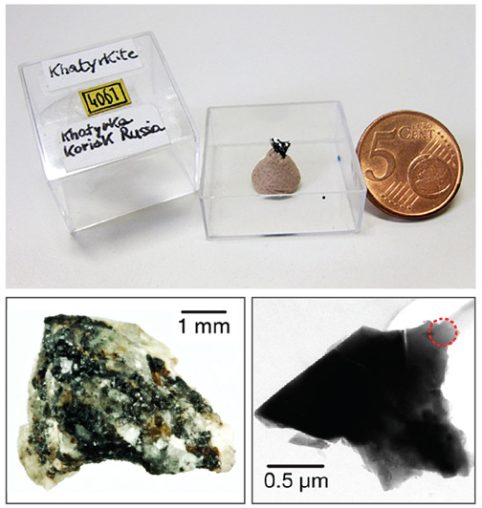
Small sample, about 3 mm across, of a Khatyrkite-bearing meteorite discovered in the mineral collection at the Museo di Storia Naturale in Florence, Italy. On January 1, 2009, Paul Steinhardt's Princeton lab identified the signature diffraction pattern of a quasicrystal embedded next to the khatyrkite and other minerals, thereby establishing evidence of the first natural quasicrystal. The sample is mounted on a pyramid-shaped piece of clay next to a 5 cent (euro) coin to illustrate its size. — Photo: Paul Steinhardt · CC BY-SA 4.0
Khatyrkite
A rare natural copper-aluminium alloy with up to ~15% zinc or iron — host of the first natural quasicrystal.
Intro adapted from Wikipedia (CC BY-SA).
Khatyrkite is an IMA-recognized mineral species in the native element class, with the chemical formula CuAl₂.
It crystallizes in the tetragonal crystal system (space group I4/mcm). It is a member of the Khatyrkite structural group.
Key properties: Mohs hardness 5.5; specific gravity 4.42; Metallic. Anisotropism: Distinct, grayish yellow to brownish red. R1 –R2: (400) —, (420) —, (440) 70.1–75.8 luster.
IMA symbol Ktk, IMA status: approved, named in 1983.
Found in black slick washed from greenish gray cover weathering from serpentine.
It is found associated with Cupalite, two unnamed zinc aluminides.
The name refers to the occurrence in the Khatyrka ultramafic zone, Russia.