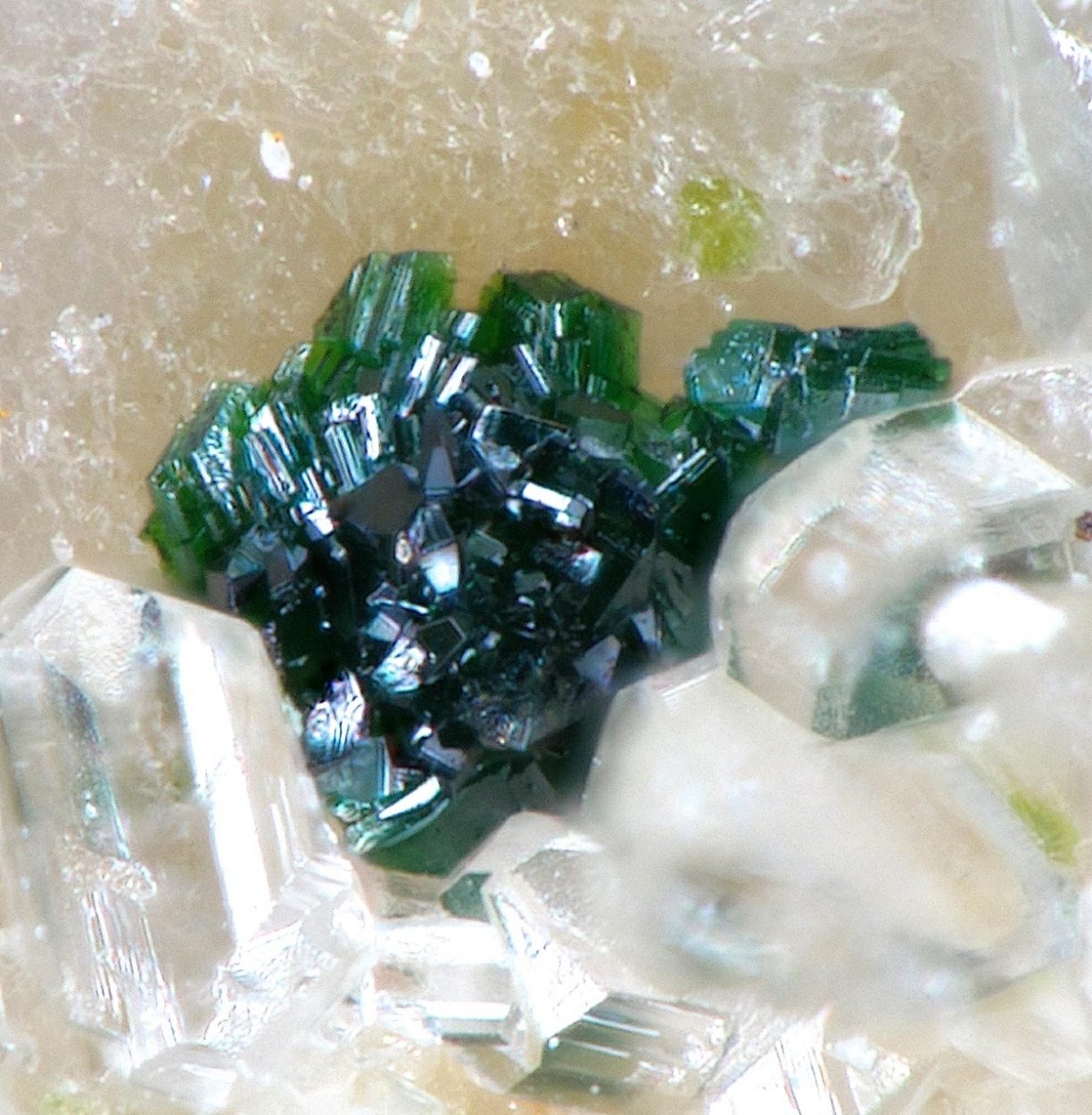
Outstanding and rich specimen of emerald green khinite microcrystals on quartz matrix associated to minoritary timroseite. From Bird Nest drift, Otto Mountain, Baker, Soda Mountains, San Bernardino County, California, United States of America. Ex. Erich Laskowski collection. — Photo: David Hospital · CC BY-SA 4.0
Khinite
A rare bottle-green lead-copper orthotellurate forming tiny orthorhombic dipyramids under a fifth of a millimetre.
Intro adapted from Wikipedia (CC BY-SA).
Khinite is an IMA-recognized mineral species in the oxides & hydroxide class, with the chemical formula Cu²⁺₃PbTe⁶⁺O₆(OH)₂.
It crystallizes in the hexagonal crystal system (space group Fdd2).
Key properties: Mohs hardness 3.5; specific gravity 6.5–7; Green streak; Vitreous luster; optically biaxial.
IMA symbol Khn, IMA status: approved, named in 1978.
A very rare secondary mineral formed under acid oxidizing conditions from gold- telluride ores in massive vein quartz.
It is found associated with Chlorargyrite, dugganite, quetzalcoatlite, tlapallite, gold, chrysocolla, tenorite, quartz (Tombstone); mojaveite, cerussite, chrysocolla, perite.
The mineral was named to honor BaSaw Khin (b. 1931), Burmese-American mineralogist, Phelps Dodge Corporation.