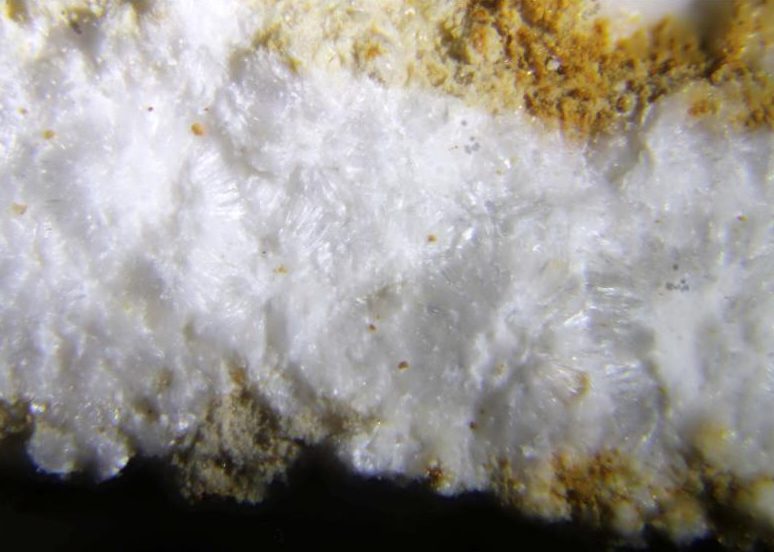
White crystal aggregates of the rare mineral kingite from Australia (Clinton Ironstone Quarry, Port Clinton, Yorke Peninsula, South Australia, Australia). Ex Vandenbroucke Museum collection from Waregem, Belgium. — Photo: David Hospital · CC BY 4.0
Kingite
A rare hydrated aluminium phosphate forming soft white nodules in phosphate deposits.
Intro adapted from Wikipedia (CC BY-SA).
Kingite is an IMA-recognized mineral species in the phosphate class, with the chemical formula Al₃(PO₄)₂F₂(OH)·7H₂O.
It crystallizes in the triclinic crystal system (space group P-1).
Key properties: specific gravity 2.21–2.3; Vitreous to dull luster.
IMA symbol Kgi, grandfathered status — known before the IMA’s founding, named in 1957.
Of secondary origin, precipitated in fractured rock by meteoric water.
It is found associated with Halite, talc, quartz, “limonite” (near Robertstown, Australia); “opal”, sanidine (Wilson Springs mine, Arkansas, USA).
The mineral was named to honor Mr. D. King (1926–1990), geologist, Department of Mines, Adelaide, South Australia, who collected the first specimens.