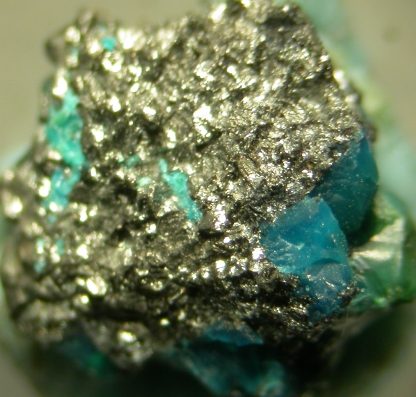
Klockmannite and Chalcomenite Locality: Sierra de Umango, La Rioja, Argentina Original description: Lustrous metallic Klockmannite (possible intergrown with some Eucairite) and blue Chalcomenite. Field of view 5 mm. — Photo: Leon Hupperichs · CC BY-SA 3.0
Klockmannite
Klockmannite is an IMA-recognized mineral species in the sulfide class, with the chemical formula Cu₅.₂Se₆.
It crystallizes in the hexagonal crystal system (space group P6_3/mmc). It is a member of the Covellite structural group.
Key properties: Mohs hardness 2–3; specific gravity 5.99; Metallic when freshly broken, soon becoming dull. Anisotropism: Strong; brownish gray to gray-white luster.
IMA symbol Kl, grandfathered status — known before the IMA’s founding, named in 1928.
Of hydrothermal origin, in deposits rich in copper and tellurium.
It is found associated with Clausthalite, umangite, eucairite, berzelianite, crookesite, chalcomenite.
The name refers to Professor Friedrich Ferdinand Hermann Klockmann (1858–1937), German mineralogist, Technical High School, Aachen, Germany.