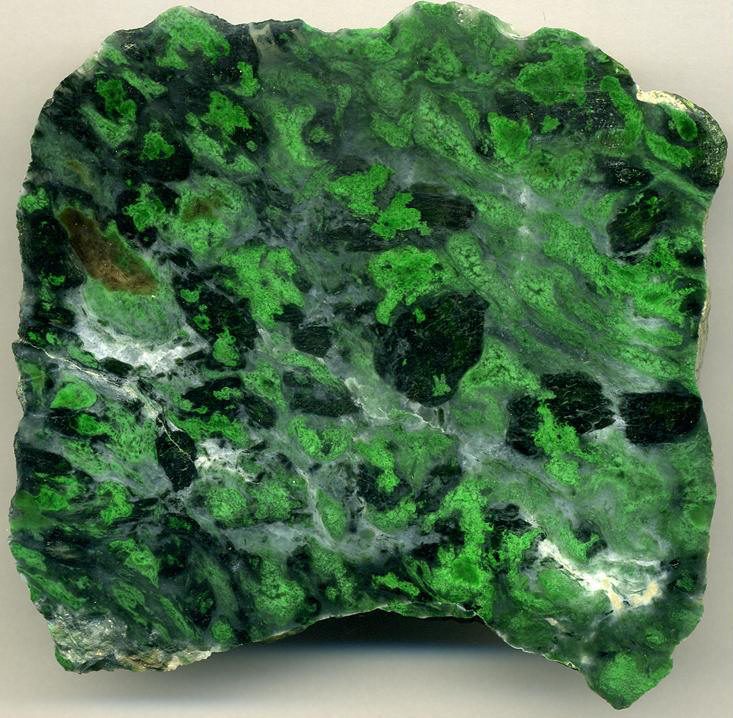
Kosmochlor jade ("maw sit sit") (8.0 cm across along the base) from the Hpakan-Tawmaw Jade Tract (near-latest Jurassic, 147 m.y.) of northern Burma. Maw sit sit is a very rare, complex, polymineralic metamorphic rock. Minerals reported in this material include chromite (metallic black, FeCr2O4), kosmochlor pyroxene (emerald green to dark green to black, NaCrSi2O6), chromian jadeite pyroxene (green, Na(Al,Fe,Cr)Si2O6), chromiferous arfvedsonite amphibole (green or gray, Cr-bearing NaNa2Fe5Si8O22(OH)2), symplectite (green, a finely-crystalline mineral mix of mostly chromian jadeite). Reported matrix minerals include thompsonite zeolite, albite feldspar, or serpentine. Maw sit sit formed under high pressure and low temperature conditions at the rim of serpentinized, chromiferous mantle peridotites. The peridotites were emplaced by obduction as oceanic lithosphere was subducting beneath the Burmese portion of southeastern Asia during the Mesozoic. Geologic unit: northeastern end of the Hpakan-Tawmaw Jade Tract, Hpakan Ultramafic Body, Naga-Adaman Ophiolite. Metamorphic age: late Tithonian Stage, near-latest Jurassic, 147 m.y. Locality: apparently an alluvial clast derived from the Namshamaw Deposit ("Namshamaw Dike"; "Maw Sit Sit Vein") at Maw Sit Sit, just northwest of Namshamaw, near Kansi (Kanzi), western Kachin State, Indo-Burma Range, northern Burma. Photo from & info. synthesized by James St. John (School of Earth Sciences, Ohio State University at Newark; Newark, Ohio, USA). — Photo: James St. John · CC BY-SA 3.0
Kosmochlor
A rare green sodium-chromium clinopyroxene found in meteorites — its name combines 'cosmic' and 'green'.
Intro adapted from Wikipedia (CC BY-SA).
Kosmochlor is an IMA-recognized mineral species in the silicate class, with the chemical formula NaCr³⁺Si₂O₆.
It crystallizes in the monoclinic crystal system (space group C2/c). It is a member of the Pyroxene structural group.
Key properties: Mohs hardness 6; specific gravity 3.51–3.6; refractive index 1.774; optically biaxial.
IMA symbol Kos, IMA status: approved, named in 1897.
A major constituent of some jadeitites; an accessory constituent of some iron meteorites.
It is found associated with \Cliftonite" [graphite], chromian diopside, troilite (Toluca); daubr¶eelite (Coahuila); krinovite, roedderite, high albite, richterite.
The name comes from the German kosmisch, for cosmic, in allusion to its meteoritic occurrence, and the Greek chlor, for green.