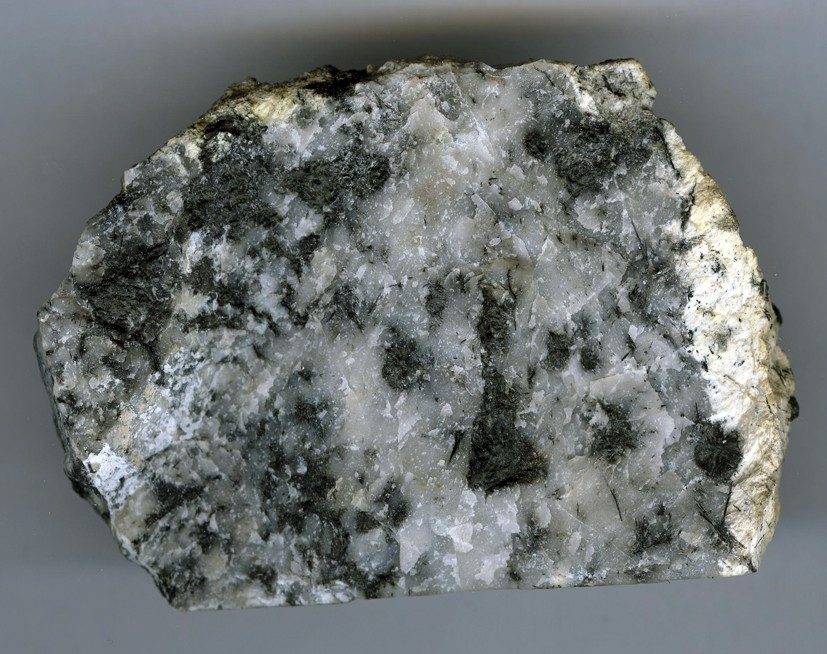
Kotoite , Ludwigite , Szaibélyite (Specimen size: 6.5 x 4.5 x 2.5 cm) Locality: Nalednoe B Deposit, Tas-Khayakhtakh Range, Dogdo River Basin, Polar Yakutia, Saha Republic (Sakha Republic; Yakutia), Eastern-Siberian Region, Russia Original description: Massive coarse-crystalline aggregate of light-grey Kotoite, formed during reaction of B-bearing solutions with layer of pure magnesite. Associating minerals are black fibrous primary Ludwigite and whitish earthy alteration crust (at right) of secondary Szaibelyite. Collected by Nikolai N. Pertsev. Pavel M. Kartashov collection and photo. — Photo: Pavel M. Kartashov · CC BY-SA 3.0
Kotoite
Kotoite is an IMA-recognized mineral species in the borate class, with the chemical formula Mg₃(BO₃)₂.
It crystallizes in the orthorhombic crystal system (space group Pnmn).
Key properties: Mohs hardness 6.5; specific gravity 3.1; Vitreous luster; optically biaxial.
IMA symbol Ko, grandfathered status — known before the IMA’s founding, named in 1939.
An uncommon mineral typically formed in the contact zone of magnesium-rich skarn borate deposits.
It is found associated with Forsterite, clinohumite, ludwigite, spinel, fluoborite, szaibélyite (Hol Kol mine, North Korea); ludwigite, suanite, szaibélyite, warwickite (Neichi mine.
The mineral was named to honor Professor Bundjiro Koto (1856–1935), Japanese geologist and petrographer, University of Tokyo, Tokyo, Japan, who studied the ore deposits of Hol Kol, North Korea.