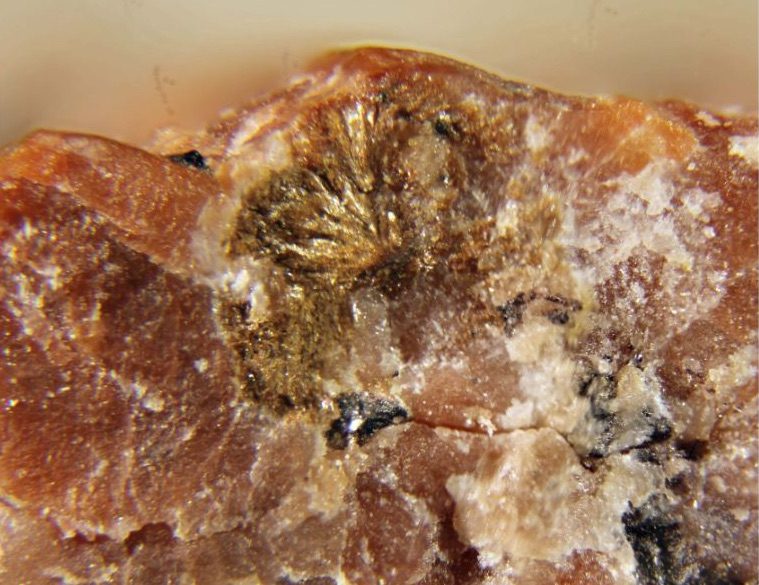
Pale brown radial crystal aggregates of the very rare mineral kraisslite from the type and only known locality worldwide in Sterling Hill (Sterling Hill, Ogdensburg, Sussex County, New Jersey, United States of America). Ex Vandenbroucke Museum collection specimen, from Waregem, Belgium. — Photo: David Hospital · CC BY-SA 4.0
Kraisslite
Kraisslite is an IMA-recognized mineral species in the silicate class, with the chemical formula Zn₃(Mn,Mg)₂₅(Fe³⁺,Al)(As³⁺O₃)₂[(Si,As⁵⁺)O₄]₁₀(OH)₁₆.
It crystallizes in the orthorhombic crystal system (space group P6_322). It is a member of the Hematolite structural group.
Key properties: Mohs hardness 3–4; specific gravity 3.876; Golden brown streak; Submetallic luster; optically uniaxial.
IMA symbol Ksl, IMA status: approved, named in 1977.
Found in the zincite zone, as films and lenses in fractures, probably of secondary origin, in a metamorphosed stratiform zinc deposit.
It is found associated with Zincite, willemite, franklinite, calcite, pyrochroite, barite, sphalerite, rhodochrosite, adelite, holdenite.
The name refers to Frederick Kraissl, Jr. (1899–1986) and Alice L. Kraissl (1905–1986), of Hackensack, New Jersey, USA.