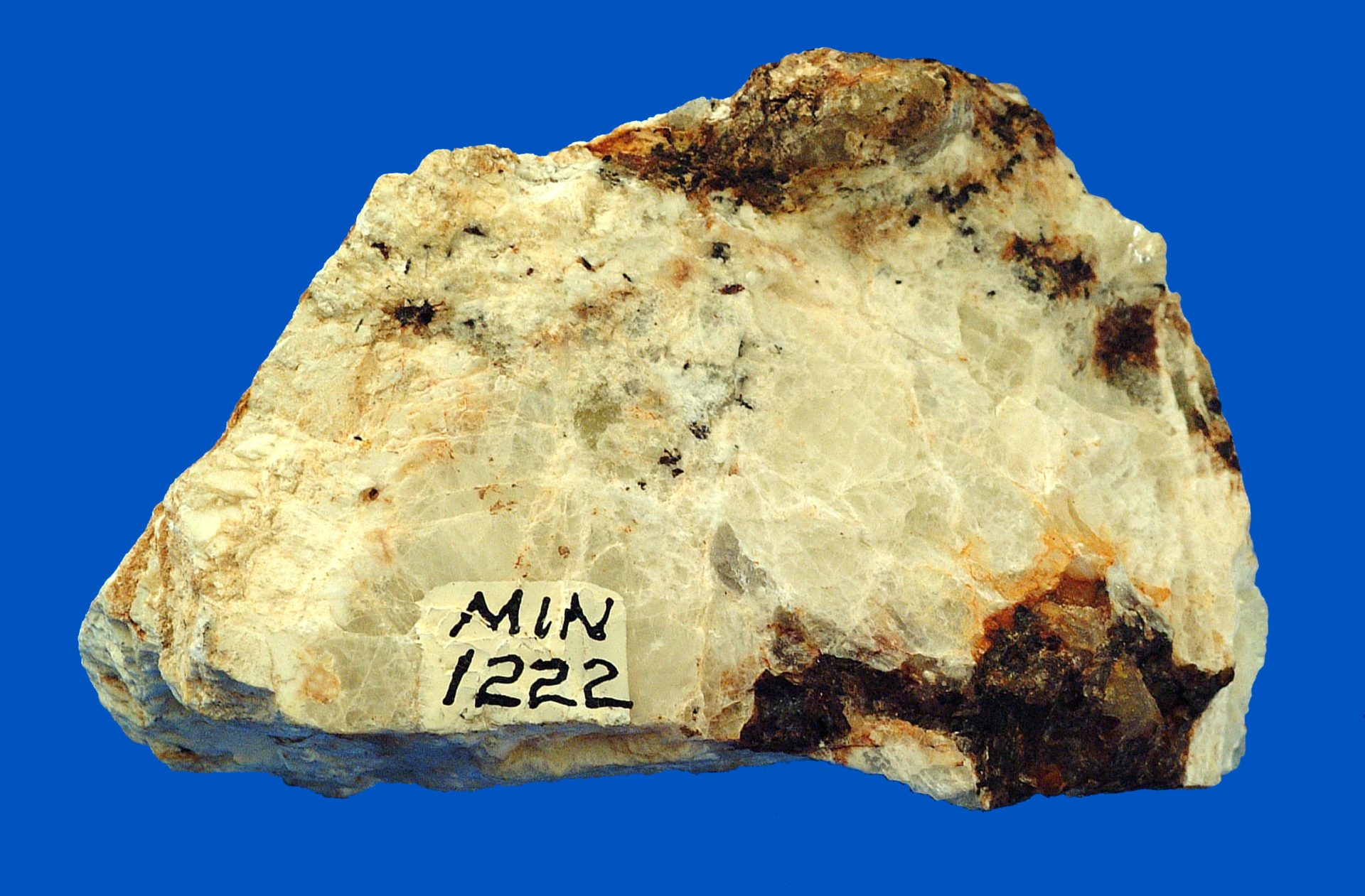
Although difficult to see, this sample contains krauskopfite (dull white mineral on left edge) replacing sanbornite (more vitreous white mineral in the center of the sample). The dark red mineral is unidentified. This specimen is from the Big Creek - Rush Creek sanbornite deposit, near Trimmer, California. Krauskopfite, a rare mineral, has composition BaSi2O4(OH)2-2H2O, and generally only forms as a replacement for sanbornite. Krauskopfite and sanbornite are two of only a few know barium minerals. This specimen is about 7 cm in length. — Photo: Twyla Baker · CC0
Krauskopfite
Krauskopfite is an IMA-recognized mineral species in the silicate class, with the chemical formula BaSi₂O₅·3H₂O.
It crystallizes in the monoclinic crystal system (space group P2_1/c).
Key properties: Mohs hardness 4; specific gravity 3.14; White streak; Subvitreous, pearly on cleavages luster; optically biaxial.
IMA symbol Kkp, IMA status: approved, named in 1964.
Found in veins cutting sanbornite-quartz-bearing gneissic metamorphic rocks.
It is found associated with Macdonaldite, \opal, " witherite, sanbornite, quartz (Rush Creek area, California, USA).
The name refers to Konrad Bates Krauskopf (1910{), Professor of Geochemistry, Stanford University, Palo Alto, California, USA.