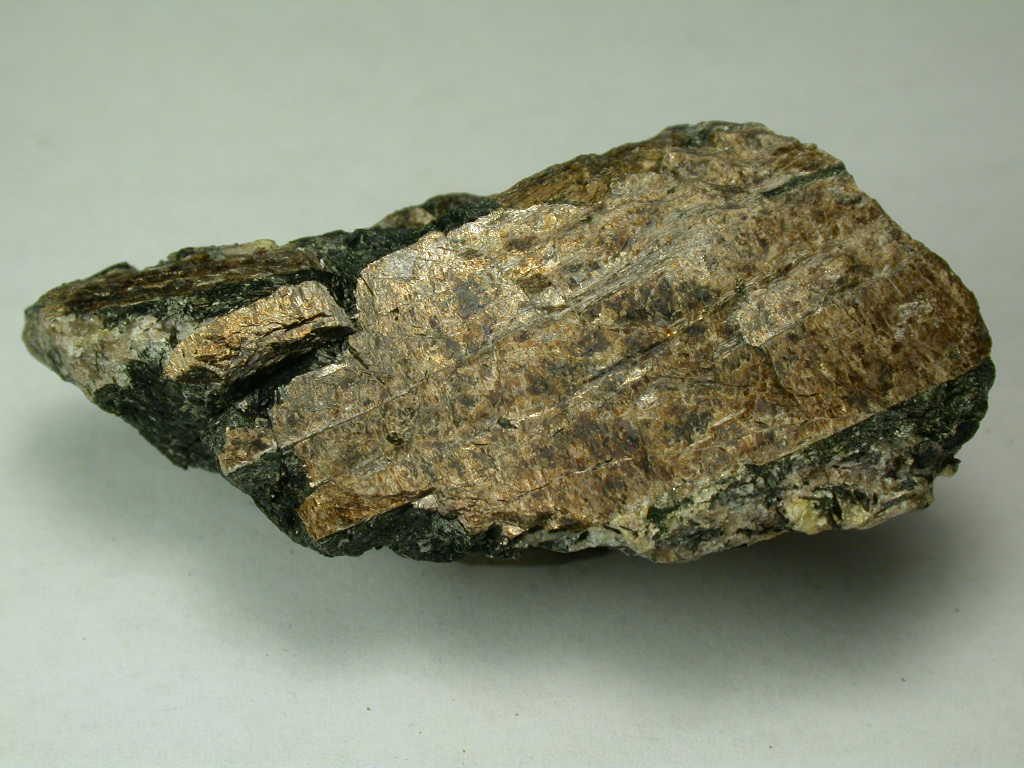
Lamprophyllite Locality: Khibiny Massif, Kola Peninsula, Murmanskaja Oblast', Northern Region, Russia Original description: A 6.7 by 3.3 cms brown crystal with some dark green Aegirine crystals. JSS specimen and photo. — Photo: John Sobolewski (JSS) · CC BY 3.0
Lamprophyllite
A yellow-to-brown titanium silicate of alkaline igneous rocks, named for the pearly luster of its cleavage surfaces.
Intro adapted from Wikipedia (CC BY-SA).
Lamprophyllite is an IMA-recognized mineral species in the silicate class, with the chemical formula (SrNa)Ti₂Na₃Ti(Si₂O₇)₂O₂(OH)₂.
It crystallizes in the monoclinic crystal system (space group C2/m). It is a member of the Seidozerite-Lamprophyllite structural group.
Key properties: Mohs hardness 2–3; specific gravity 3.44–3.53; Pale yellow, may have an orange tint streak; Submetallic on cleavages luster; optically biaxial.
IMA symbol Lmp, IMA status: approved, named in 1894.
Found in all rock types and most pegmatites of a differentiated alkalic massif; both polytypes coexist in ussingite-microcline-sodalite veins at Mt. Alluaiv (Lovozero massif, Russia).
It is found associated with Microcline, nepheline, aegirine, ussingite, sodalite, albite, manganneptunite, vuonnemite, sphalerite, lomonosovite, betalomonosovite (Lovozero massif.
Its name comes from the Greek for shining and leaf, for its lustrous cleavage.