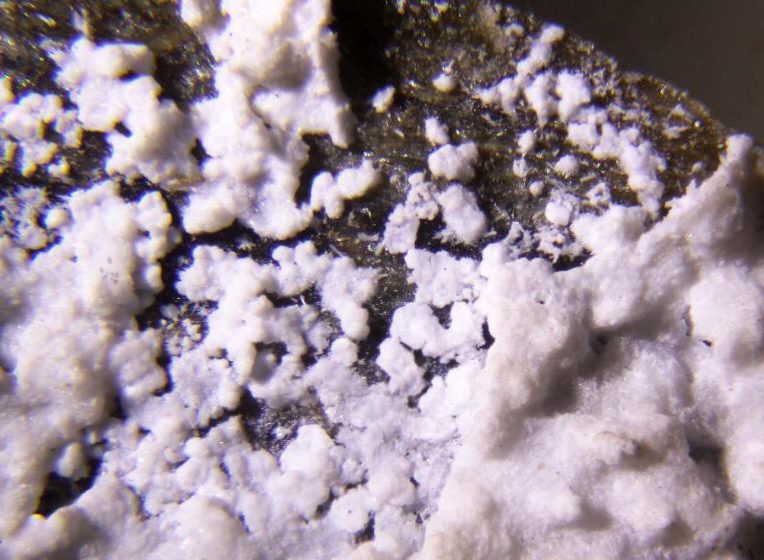
White crystal aggregates of the rare Mg carbonate mineral lansfordite from a locality in Switzerland (Findel Glacier, Zermatt, Zermatt - Saas Fee Area, Valais, Switzerland). Ex. Erich Laskowski collection (USA). — Photo: David Hospital · CC BY 4.0
Lansfordite
Magnesium carbonate pentahydrate — a soft white mineral discovered in 1888 in a coal mine at Lansford, Pennsylvania.
Intro adapted from Wikipedia (CC BY-SA).
Lansfordite is an IMA-recognized mineral species in the carbonate class, with the chemical formula Mg(CO₃)·5H₂O.
It crystallizes in the monoclinic crystal system (space group P2_1/c).
Key properties: Mohs hardness 2.5; specific gravity 1.692; Vitreous if fresh luster; optically biaxial.
IMA symbol Lfd, grandfathered status — known before the IMA’s founding, named in 1888.
Stalactites pendant from the shale roof of an anthracite coal mine (Nesquehoning, Pennsylvania, USA); in a hydromagnesite deposit (Atlin, Canada); a weathering product of an ultramafic body (Sør-Trøndelag, Norway).
It is found associated with Nesquehonite, hydromagnesite, dypingite.
The name refers to its occurrence near Lansford, Pennsylvania, USA.