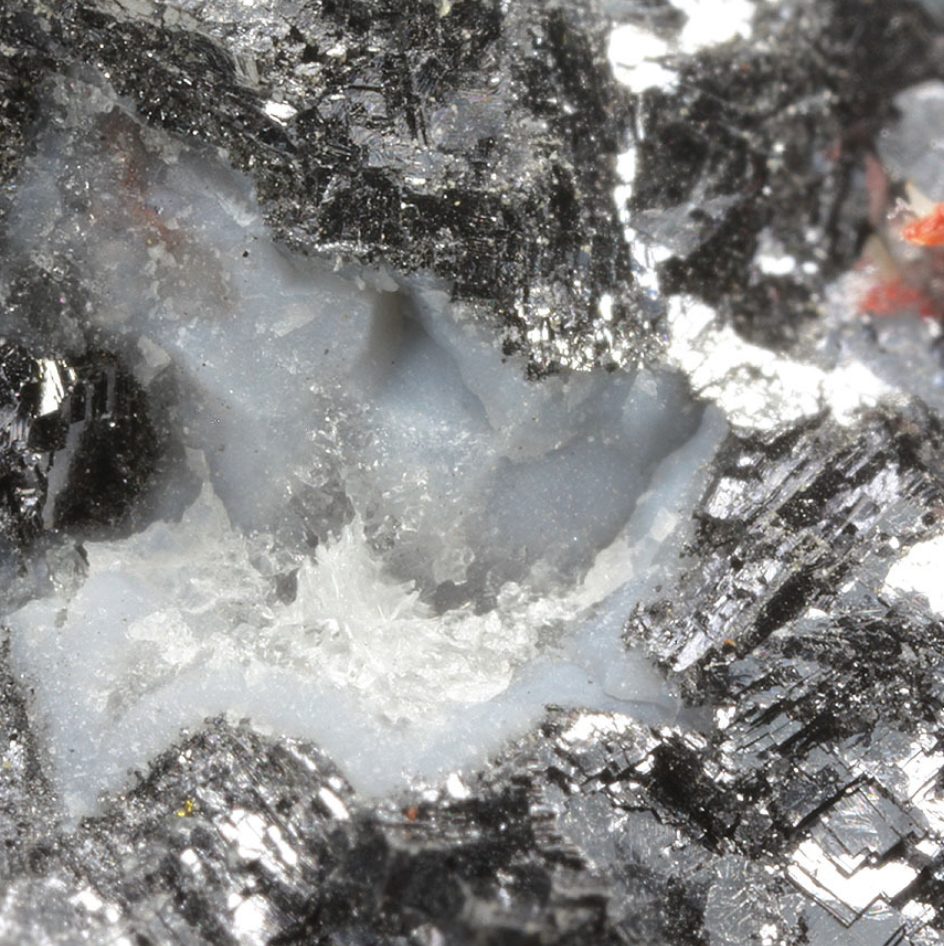
:2.2 x 1.7 x 1.2 cm. Laurelite is a very rare lead halide species that is only found in two confirmed localities (with a third questionable locality) in the world. This piece just happens to be from the type locality for the species, the Grand Reef Mine in Arizona. The species is named for Laurel Canyon in which the mine resides. Micro white fibrous crystals of laurelite can be seen on the specimen in association (according to the label) with artroeite, aravaipaite, calcioaravapaite with quartz and galena. I can confirm the laurelite, but I cannot say for certain if artroeite, aravaipaite and calcioaravapaite are actually present. From the collection of Paolo Matioli. Locality: Grand Reef Mine, Laurel Canyon, Grand Reef Mountain, Klondyke, Santa Teresa Mts, Aravaipa District, Graham Co., Arizona, USA — Photo: Robert M. Lavinsky · CC BY-SA 3.0
Laurelite
Laurelite is an IMA-recognized mineral species in the halide class, with the chemical formula Pb₇F₁₂Cl₂.
It crystallizes in the hexagonal crystal system (space group P-6).
Key properties: Mohs hardness 2; specific gravity 7.65; White streak; Silky, subadamantine on broken surfaces luster; optically uniaxial.
IMA symbol Lrl, IMA status: approved, named in 1988.
Found in a vug isolated from acidic sulfate-rich solutions in the oxidized zone of a low-temperature Pb–Cu–Ag deposit.
It is found associated with Grandreefite, pseudograndreefite, aravaipaite, galena, fluorite, anglesite, linarite, caledonite, quartz.
The name refers to Laurel Canyon, Arizona, USA, where the Grand Reef mine is located.