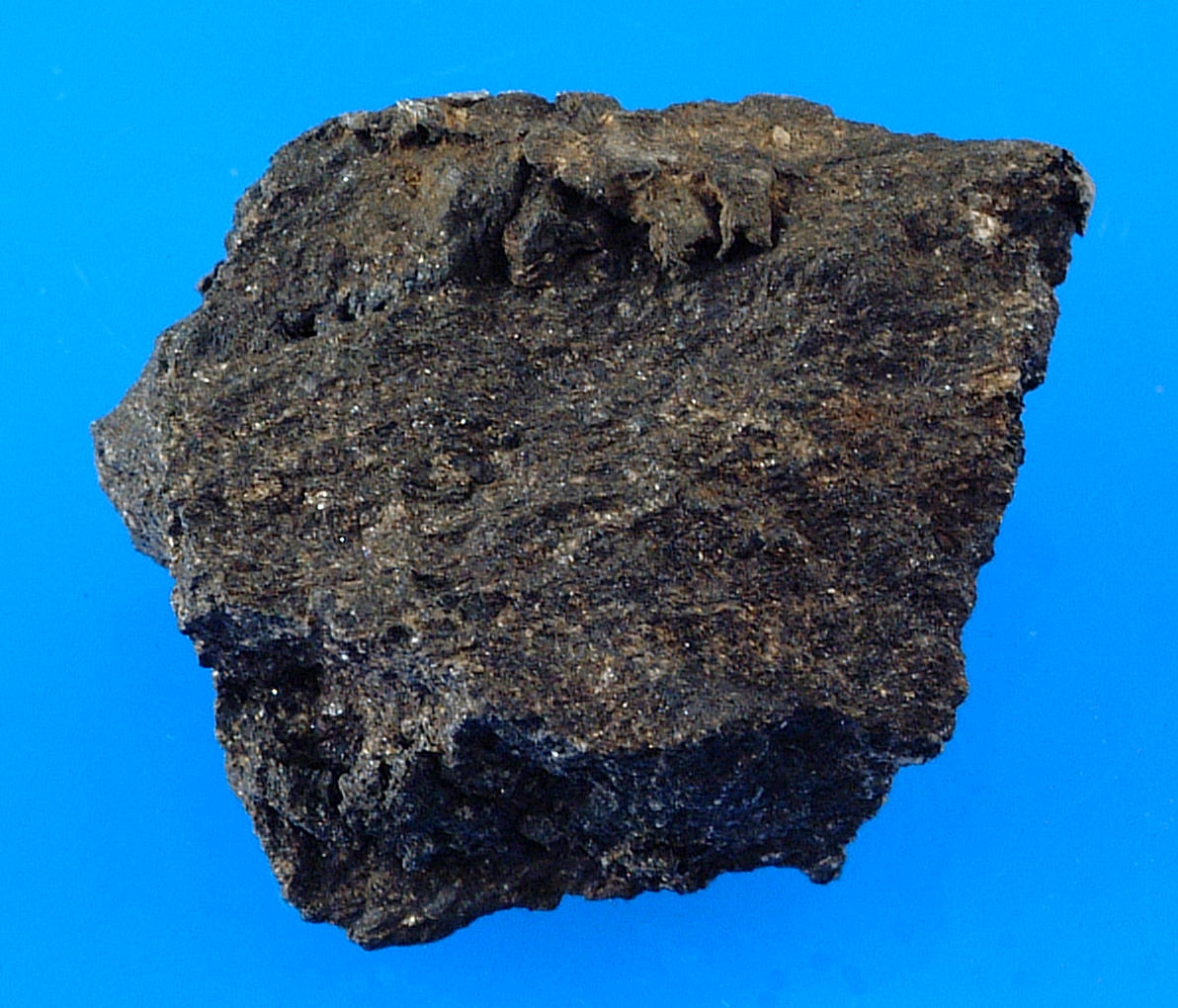
Lead is extremely rare as a mineral, though the element itself is somewhat common. This sample contains native lead and hausmannite, Mn2O4. It is 3 cm across. T — Photo: Shannon Heinle · CC0
Lead
The heavy metal Pb (atomic number 82) — soft, dense and easily worked; a native element in rare specimens and the prize of galena mines.
Intro adapted from Wikipedia (CC BY-SA).
Lead is an IMA-recognized mineral species in the native element class, with the chemical formula Pb.
It crystallizes in the cubic crystal system (space group Fm3m). It is a member of the Copper structural group.
Key properties: Mohs hardness 1.5; specific gravity 11.37; typically gray; Lead-gray streak; Metallic. R: (400) 68.7, (420) 69.0, (440) 69.4, (460) 69.5, (480) 69.6, (500) 69.7, (520) 69.8, (540) 69.6 luster.
IMA symbol Pb, grandfathered status — known before the IMA’s founding.
A rare mineral of hydrothermal origin, and found in placers; possibly also formed by authigenic processes and known to replace tree roots.
It is found associated with Hydrocerussite, caryopilite, sarkinite, brandtite (Harstigen mine, Sweden); galena, minium, cerussite (Jay Gould mine, Idaho, USA; Red Cap mine, Australia).
An Old English word for the metal; the chemical symbol from the Latin plumbum.
Collections: Metals & Native Elements, Rare & Remarkable.