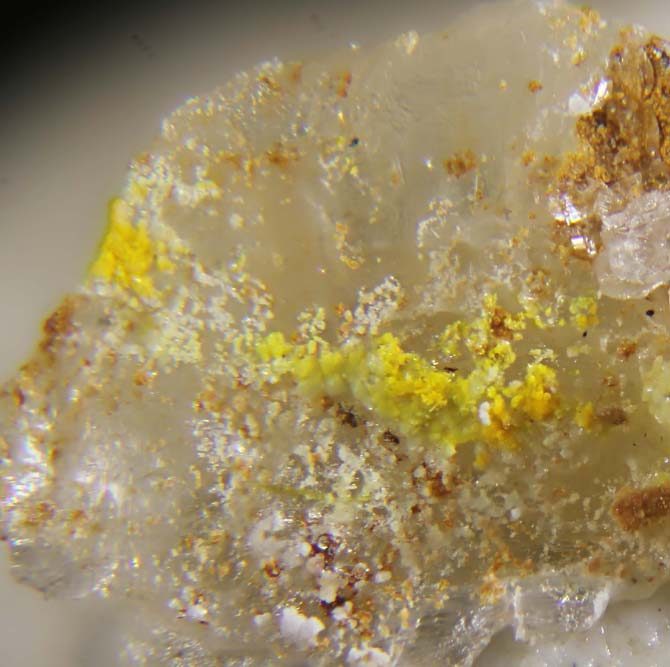
Yellow-orange crystals of the extremely rare mineral leesite (IMA 2016-084) from the type and only known locality worldwide in Utah: Jomac Mine, San Juan County, Utah, United States of America. — Photo: David Hospital · CC BY-SA 4.0
Leesite
Leesite is an IMA-recognized mineral species in the oxides & hydroxide class, with the chemical formula K(H₂O)₂[(UO₂)₄O₂(OH)₅]·3H₂O.
It crystallizes in the orthorhombic crystal system (space group Pbca). It is a member of the Schoepite structural group.
Key properties: Mohs hardness 2; specific gravity 3.256; Light yellow streak; Vitreous luster; optically biaxial.
IMA symbol Lee, IMA status: approved, named in 2016.
Collected in an abandoned mine tunnel in a roll-front uranium deposit.
It is found associated with Gypsum, compreignacite, sklodowskite, blatonite, owsaldpeetersite, alunite, chalcoalumite, probable mbobomkulite or nickelalumite, boltwoodite.
The mineral was named to honor American mineral dealer and collector Bryan K. Lees (b. 1957), recipient of the Friends of Mineralogy Author of the Year Award (1998).