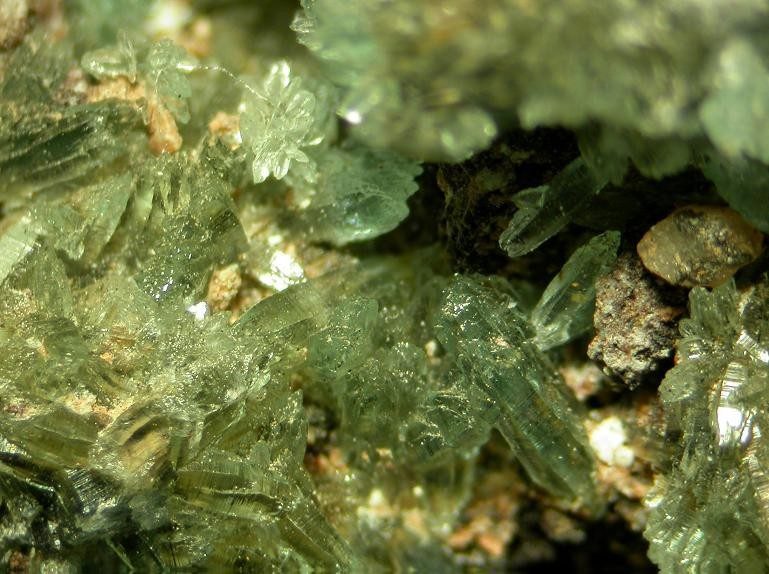
Leightonite Locality: Salvadora mine, Caracoles, Sierra Gorda district, Tocopilla province, Antofagasta Region, Chile Field of view 7 mm. Specimen and photo Leon Hupperichs. — Photo: Leon Hupperichs · CC BY-SA 3.0
Leightonite
A rare hydrated potassium-calcium-copper sulfate.
Intro adapted from Wikipedia (CC BY-SA).
Leightonite is an IMA-recognized mineral species in the sulfate class, with the chemical formula K₂Ca₂Cu(SO₄)₄·2H₂O.
It crystallizes in the monoclinic crystal system (space group C2/c).
Key properties: Mohs hardness 3; specific gravity 2.95; Vitreous luster; refractive index 1.587; optically biaxial.
IMA symbol Lgh, grandfathered status — known before the IMA’s founding, named in 1938.
Of localized occurrence in the oxidized zone of a copper deposit, probably formed under conditions of low acidity (Chuquicamata, Chile).
It is found associated with Natrochalcite, blödite, atacamite, bellingerite, kröhnkite, gypsum, quartz (Chuquicamata, Chile); chalcanthite, anhydrite, lammerite (Tsumeb, Namibia).
The mineral was named to honor Tomás Leighton Donoso (1896–1967), Chilean mining engineer and Professor of Mineralogy, University of Santiago, Santiago, Chile.