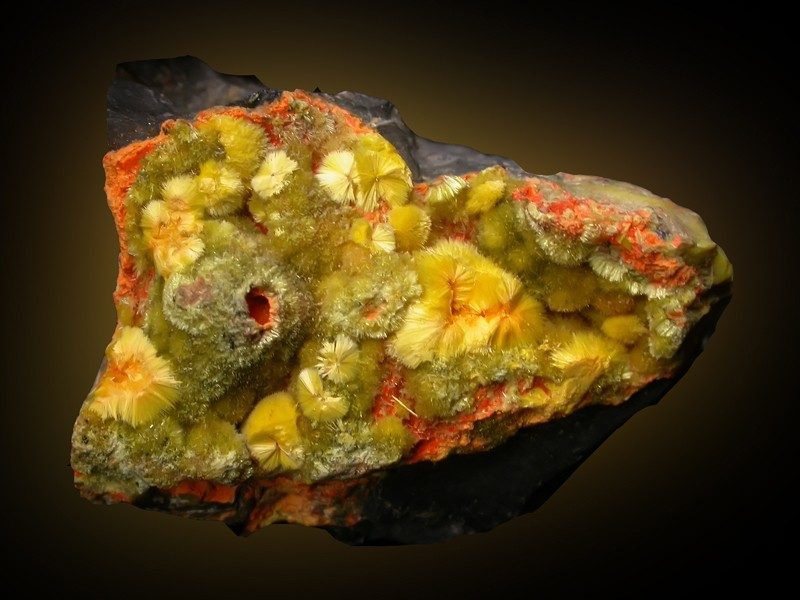
Lepersonnite-(Gd) , Studtite , Curite , Uraninite Locality: Shinkolobwe Mine (Kasolo Mine), Shinkolobwe , Central area, Katanga Copper Crescent, Katanga (Shaba) , Democratic Republic of Congo (Zaïre) ( Locality at mindat.org ) Size: 2.4 x 1.5 x 2 cm. Lepersonnite-(Gd) is a very rare REE-uranyl carbonate from Shinkolobwe. Here it is intergrown in the yellow Studtite clusters (surrounded by smaller Uranophane xls). The difference is obvious and visible under magnification where the Lepersonnite-(Gd) forms flat crystals while the Studtite forms needles. The orange mineral is Curite. The Shinkolobwe mine is closed since the late 1950’s and is the type locality for all three of these: Lepersonnite-(Gd), Studtite and Curite. This Photo was Mindat.org Photo of the Day - 7th Feb 2010 — Photo: Robert M. Lavinsky · CC BY-SA 3.0
Lepersonnite-(Gd)
Lepersonnite-(Gd) is a very rare uranium and rare-earth mineral with the chemical formula Ca(Gd,Dy)2(UO2)24(SiO4)4(CO3)8(OH)24·48H2O. It occurs with bijvoetite-(Y) in the Shinkolobwe deposit in the Democratic Republic of the Congo, famous for rare uranium minerals. It was the first confirmed mineral with essential gadolinium and remained the only gadolinium dominant species until the description of Monazite-(Gd) in 2023. It was first described in 1982 and is named after the Belgian geologist Jacques Lepersonne.
Intro adapted from Wikipedia (CC BY-SA).
Lepersonnite-(Gd) is an IMA-recognized mineral species in the silicate class, with the chemical formula CaGd₂(UO₂)₂₄(CO₃)₈Si₄O₂₈·60H₂O.
It crystallizes in the orthorhombic crystal system. It is a member of the Lepersonnite structural group.
Key properties: specific gravity 3.97; optically biaxial.
IMA symbol Lps-Gd, IMA status: approved, named in 1981.
Found in the lower portion of the oxidation zone developed above uraninite-bearing dolomitic rocks.
It is found associated with Bijvoetite, sklodowskite, curite, uranophane, becquerelite, rutherfordine, studtite.
The name refers to Jacques Lepersonne, honorary Head of the Department of Geology and Mineralogy, Royal Museum of Central Africa, Tervuren, Belgium, and for its gadolinium content.