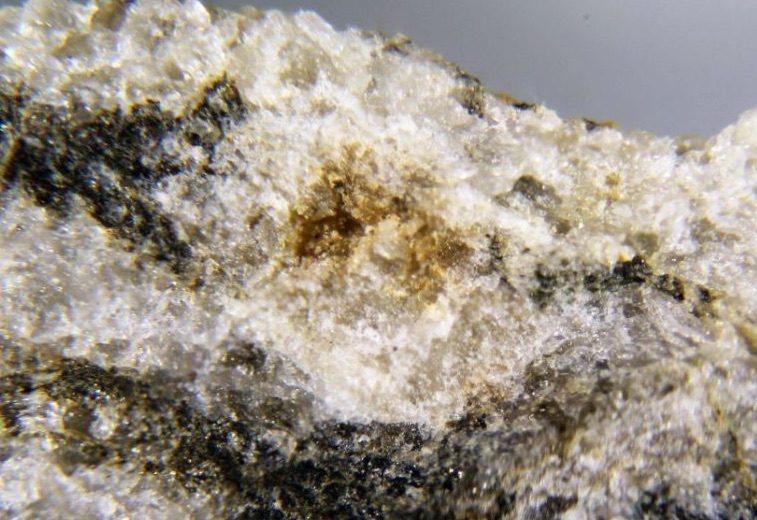
Colorless to pale yellow inclusions of the very rare K-Al silicate mineral lithosite from the type and only known locality worldwide (Vuonnemiok River Valley, Khibiny Massif, Murmansk Oblast, Russian Federation), in a polished section that was used for analysis by the former owner of the specimen (the Vandenbroucke Museum). Ex Vandenbroucke Museum collection from Waregem, Belgium. — Photo: David Hospital · CC BY-SA 4.0
Lithosite
Lithosite is an IMA-recognized mineral species in the silicate class, with the chemical formula K₃Al₂Si₄O₁₂(OH).
It crystallizes in the monoclinic crystal system (space group P2_1).
Key properties: Mohs hardness 5.5; specific gravity 2.51; Vitreous luster; optically biaxial.
IMA symbol Lho, IMA status: approved, named in 1982.
A secondary mineral from the weathering of ultraperalkalic pegmatite veins cutting nepheline syenites in a differentiated alkalic massif.
It is found associated with Shafranovskite, lomonosovite, lamprophyllite, catapleiite, koashvite, zirsinalite, sodalite, aegirine, pectolite, molybdenite.
Its name comes from the Greek lithos, for stone, as the mineral is composed of the most abundant chemical elements of the crust of the earth.