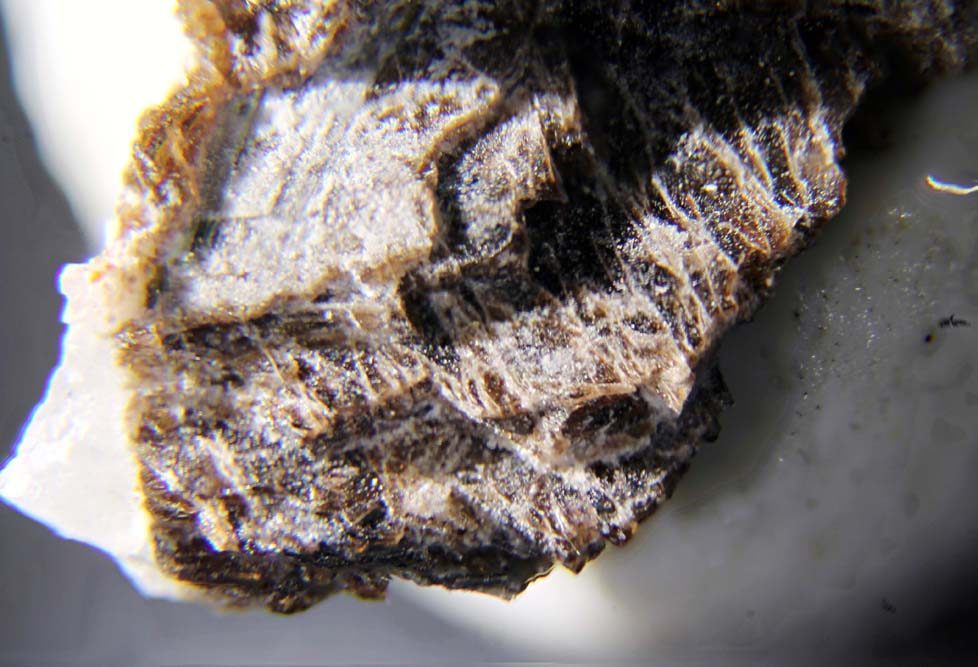
Whitish (somewhat platy) bornemanite with brownish (mainly beige) platy lomonosovite from the type locality for bornemanite: Yubileinaya Pegmatite, Lovozero Massif, Kola, Russian Federation. — Photo: David Hospital · CC BY-SA 4.0
Lomonosovite
A complex sodium-titanium phosphate-silicate of alkaline intrusions, carrying niobium and other substitutions.
Intro adapted from Wikipedia (CC BY-SA).
Lomonosovite is an IMA-recognized mineral species in the silicate class, with the chemical formula Na₆Na₂Ti₂Na₂Ti₂(Si₂O₇)₂(PO₄)₂O₄.
It crystallizes in the triclinic crystal system (space group P-1). It is a member of the Seidozerite-Murmanite structural group.
Key properties: Mohs hardness 3–4; specific gravity 2.88–3.13; Light rose-cinnamon streak; Vitreous to adamantine on cleavages, greasy on fractures luster; optically biaxial.
IMA symbol Lom, IMA status: approved, named in 1950.
Found in nepheline syenites and pegmatites cutting them (Lovozero massif, Russia); in lavas and gabbros near contacts with nepheline syenite (Il¶³maussaq intrusion, Greenland).
It is found associated with Nepheline, albite, pectolite, lorenzenite, ussingite, lamprophyllite, eudialyte, arfvedsonite, villiaumite, aegirine, and many other species.
The name refers to Mikhail Vasil'evich Lomonosov (1711–1765), Russian mineralogist and naturalist.