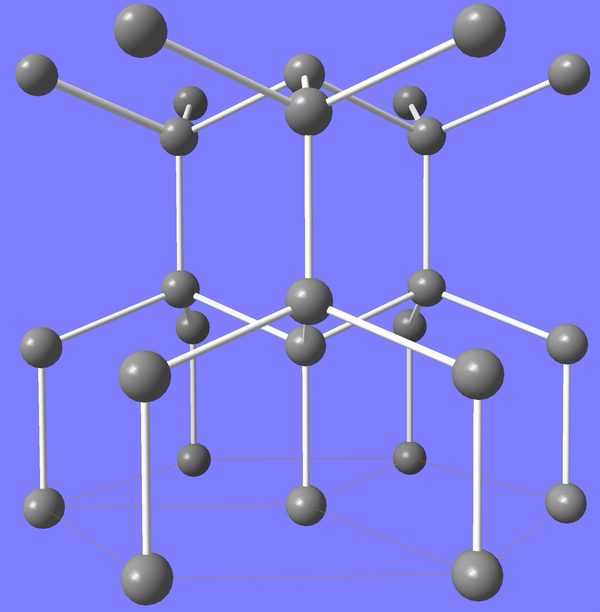
Crystal structure of lonsdaleite (hexagonal diamond) — Photo: Materialscientist ( talk ) · CC BY-SA 3.0
Lonsdaleite
Hexagonal diamond — the carbon allotrope formed by meteorite impacts, theoretically harder than cubic diamond.
Intro adapted from Wikipedia (CC BY-SA).
Lonsdaleite is an IMA-recognized mineral species in the native element class, with the chemical formula C.
It crystallizes in the hexagonal crystal system (space group P6_3/mmc).
Key properties: Mohs hardness 3; specific gravity 3.2; Adamantine luster.
IMA symbol Lon, IMA status: approved, named in 1966.
Discovered in the residue (ca. 200 mg) from the dissolution of 5 kg of Cañon Diablo meteorite. The mineral may be formed by impact shock, or be a product of direct crystallization in the parent body.
It is found associated with Schreibersite, cohenite, taenite, graphite, chromite, kosmochlor, sphalerite, black diamond (Cañon Diablo); troilite, graphite, diamond, schreibersite.
The mineral was named to honor Professor Kathleen (Yardley) Lonsdale (1903–1971), distinguished British crystallographer, University of London, London, England.