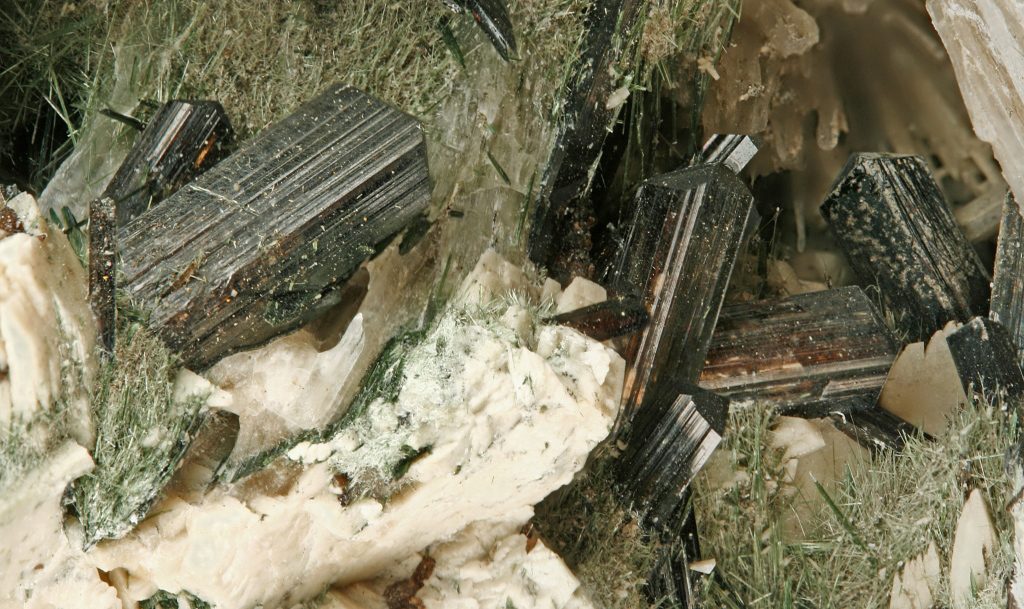
Lorenzenite Locality: Khibiny Massif, Kola Peninsula, Murmanskaja Oblast', Northern Region, Russia The largest xl is ~ 9 mm tip to tip. Via Fersman Museum. MOB coll. The lorenzenite xsl appear black but the smallest xls on the specimen are actually translucent with a beautiful deep red color — Photo: Modris Baum · Public domain
Lorenzenite
A rare sodium-titanium silicate first identified in 1897 in rocks from Narsarsuk, Greenland.
Intro adapted from Wikipedia (CC BY-SA).
Lorenzenite is an IMA-recognized mineral species in the silicate class, with the chemical formula Na₂Ti₂O₃(Si₂O₆).
It crystallizes in the orthorhombic crystal system (space group Pbcn).
Key properties: Mohs hardness 6; specific gravity 3.42–3.45; Vitreous, adamantine to submetallic, or silky, dull luster; refractive index 2.001; optically biaxial.
IMA symbol Lrz, grandfathered status — known before the IMA’s founding, named in 1901.
Found in nepheline syenites and their associated pegmatites.
It is found associated with Aegirine, nepheline, microcline, arfvedsonite, elpidite, loparite, eudialyte, astrophyllite, mangan-neptunite, lº avenite, rinkite, apatite, titanite, ilmenite.
The name commemorates Johannes Theodor Lorenzen (1855–1884), Danish mineralogist interested in Greenland minerals.