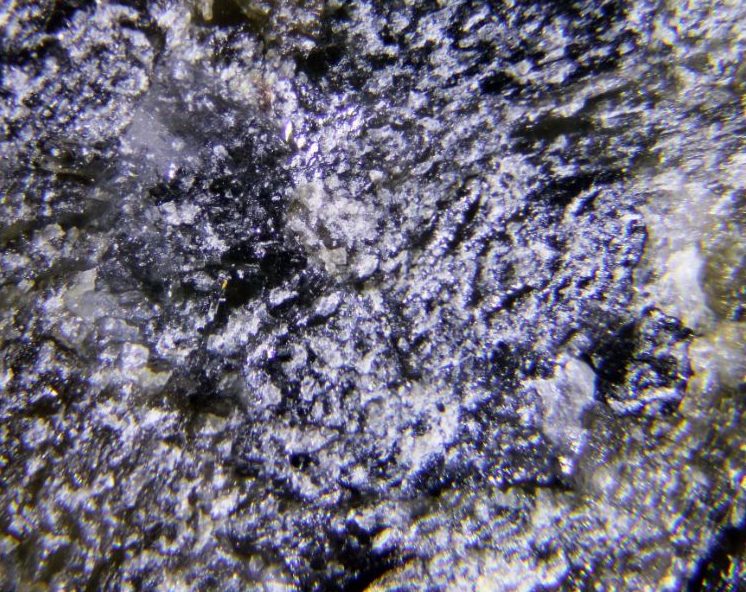
Black inclusions of the very rare mineral loveringite from the type locality in Australia (Jimberlana Intrusion, Norseman, Dundas Shire, Western Australia). Ex Vandenbroucke Museum collection from Waregem, Belgium. — Photo: David Hospital · CC BY-SA 4.0
Loveringite
A rare calcium-cerium titanate of the crichtonite group, crystallizing in late melts of layered mafic intrusions.
Intro adapted from Wikipedia (CC BY-SA).
Loveringite is an IMA-recognized mineral species in the oxides & hydroxide class, with the chemical formula (Ca,Ce,La)(Zr,Fe)(Mg,Fe)₂(Ti,Fe,Cr,Al)₁₈O₃₈.
It crystallizes in the hexagonal crystal system (space group R-3). It is a member of the Crichtonite structural group.
Key properties: Mohs hardness 7.5; specific gravity 4.42; Iron-gray streak; Metallic to submetallic luster; optically uniaxial.
IMA symbol Lvg, IMA status: approved, named in 1977.
A late-stage mineral from residual intercumulus magma in the pyroxene, olivine-chromite, or plagioclase-rich layers of mafic intrusions.
It is found associated with Quartz, potassium feldspar, phlogopite, enstatite, baddeleyite, apatite, zircon, titanite, rutile, ilmenite, chromite (near Norseman, Australia); rutile.
The mineral was named to honor Professor John Francis Lovering (1930–), Australian geochemist, University of Melbourne, Melbourne, Australia, for his work on fission-track methods in geochemistry.