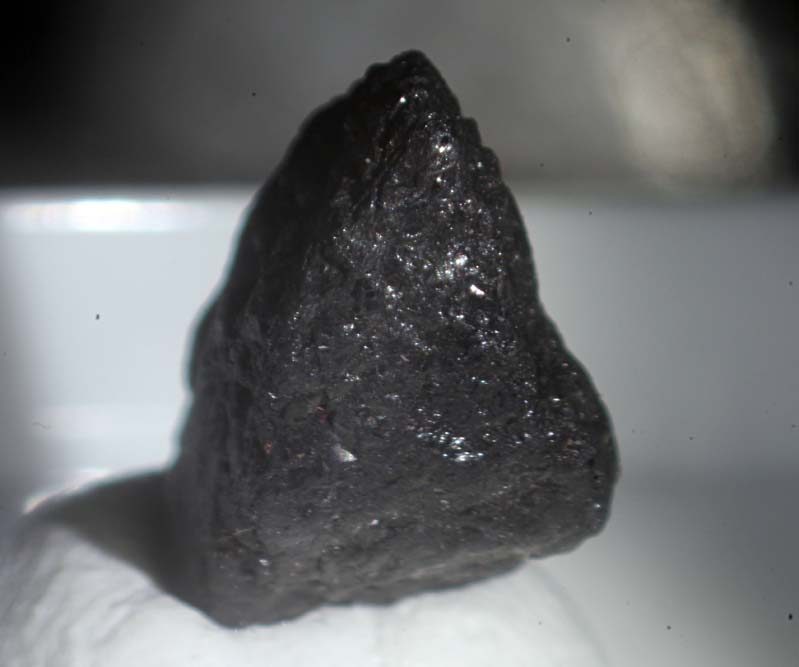
Outstanding black crystal of the extremely rare mineral lucchessite (IMA 2015-043) from the type (Ratnapura, Sabaragamuwa Province, Sri Lanka) and only one of the two localities known worldwide. — Photo: David Hospital · CC BY-SA 4.0
Lucchesiite
The calcium-oxygen analogue of schorl — a black tourmaline with type localities in the Czech Republic and Sri Lanka.
Intro adapted from Wikipedia (CC BY-SA).
Lucchesiite is an IMA-recognized mineral species in the silicate class, with the chemical formula CaFe²⁺₃Al₆(Si₆O₁₈)(BO₃)₃(OH)₃O.
It crystallizes in the hexagonal crystal system (space group R3m). It is a member of the Tourmaline structural group.
Key properties: Mohs hardness 7; specific gravity 3.209; Gray streak; Vitreous luster; optically uniaxial.
IMA symbol Lcc, IMA status: approved, named in 2015.
Occurs as graphic intergrowths, in the central parts of a contaminated anatectic pegmatite dike (Czech Republic). In gem-bearing alluvial gravels (“illam”) (Sri Lanka).
It is found associated with Ca-rich schorl, plagioclase (An 30-42), K-feldspar, quartz (Czech Republic).
The mineral was named to honor Sergio Lucchesi (1958-2010), professor of mineralogy, Sapienza University, Rome, Italy, for his contributions to the study of tourmaline and spinel crystal chemistry.