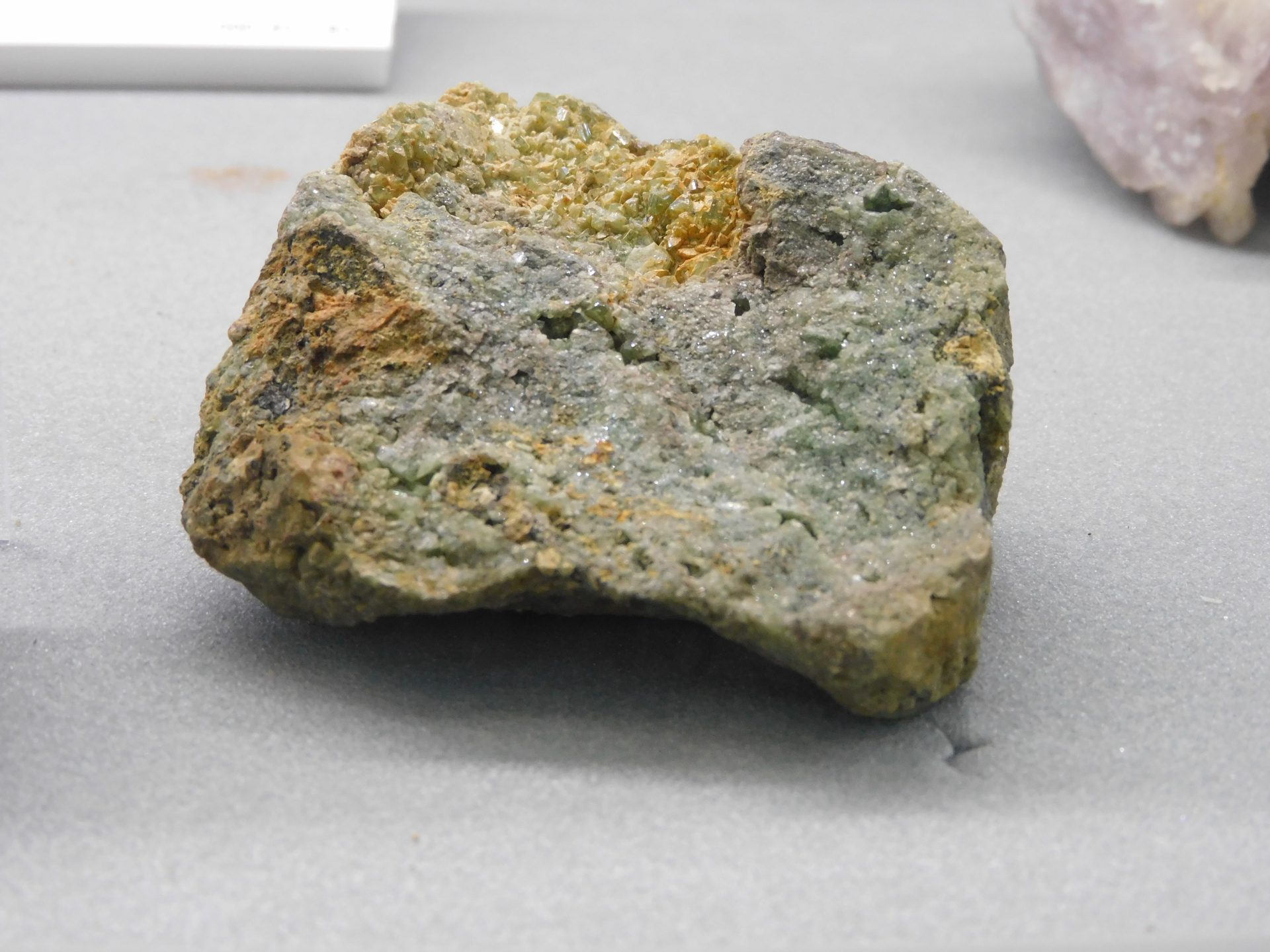
This is Ludlamite from Ashio Mine, Nikko, Tochigi, Japan. It is owned by Tochigi prefectural museum. — Photo: Miyuki Meinaka · CC BY-SA 4.0
Ludlamite
A rare bright-green hydrated iron phosphate described in 1877 from Cornwall's Wheal Jane mine, named for Henry Ludlam.
Intro adapted from Wikipedia (CC BY-SA).
Ludlamite is an IMA-recognized mineral species in the phosphate class, with the chemical formula Fe²⁺₃(PO₄)₂·4H₂O.
It crystallizes in the monoclinic crystal system (space group P2_1/a).
Key properties: Mohs hardness 3.5; specific gravity 3.12–3.19; Pale greenish white streak; Vitreous, pearly on {001} cleavage luster; refractive index 1.672; optically biaxial.
IMA symbol Lud, grandfathered status — known before the IMA’s founding, named in 1885.
Found in complex granite pegmatites, a common hydrothermal alteration product of earlier phosphates, formed under reducing conditions.
It is found associated with Phosphoferrite, triploidite, triplite, triphylite, apatite (Hagendorf, Germany); fairfieldite, vivianite, siderite, whitlockite (Palermo #1 mine.
The mineral was named to honor Henry Ludlam (1824–1880), English mineral collector, London, England.