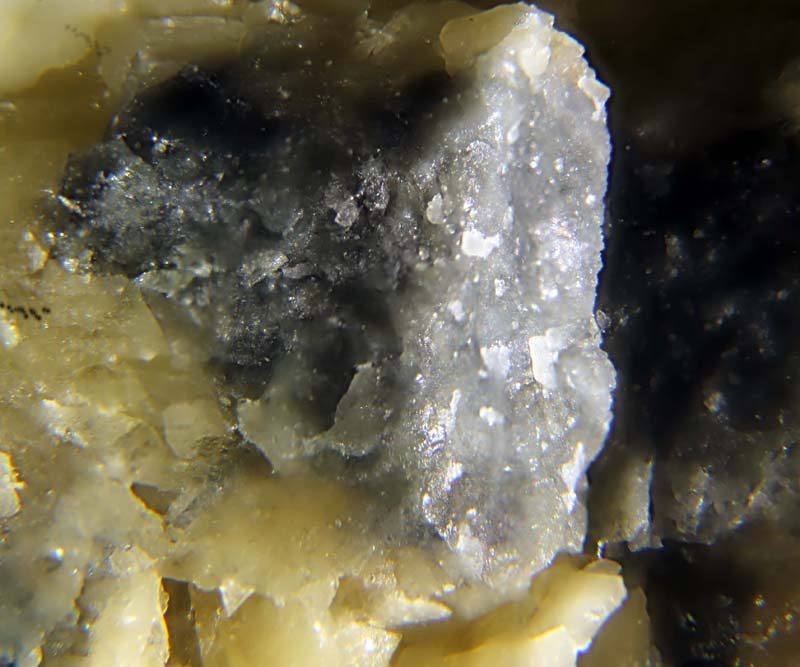
Grey crystal aggregates of the extremely rare mineral luzlacite from the type and only known locality worldwide: Bois De La Roche Quarry, Saint Aubin des Chateaux, Pays de Loire, France. — Photo: David Hospital · CC BY-SA 4.0
Lulzacite
A strontium-bearing iron-aluminium phosphate described in 2000 from French quartzites.
Intro adapted from Wikipedia (CC BY-SA).
Lulzacite is an IMA-recognized mineral species in the phosphate class, with the chemical formula Sr₂Fe²⁺₃Al₄(PO₄)₄(OH)₁₀.
It crystallizes in the triclinic crystal system (space group P-1).
Key properties: Mohs hardness 5.5–6; specific gravity 3.55; Vitreous luster; refractive index 1.671; optically biaxial.
IMA symbol Lul, IMA status: approved, named in 1998.
Found in hydrothermal veinlets in association with metamorphism at the contact between quartzite and ironstone.
It is found associated with Siderite, pyrite, goyazite, apatite, quartz, calcite, marcasite, pyrrhotite.
The mineral was named to honor geologist Y. Lulzac (b. 1934), who discovered the mineral.