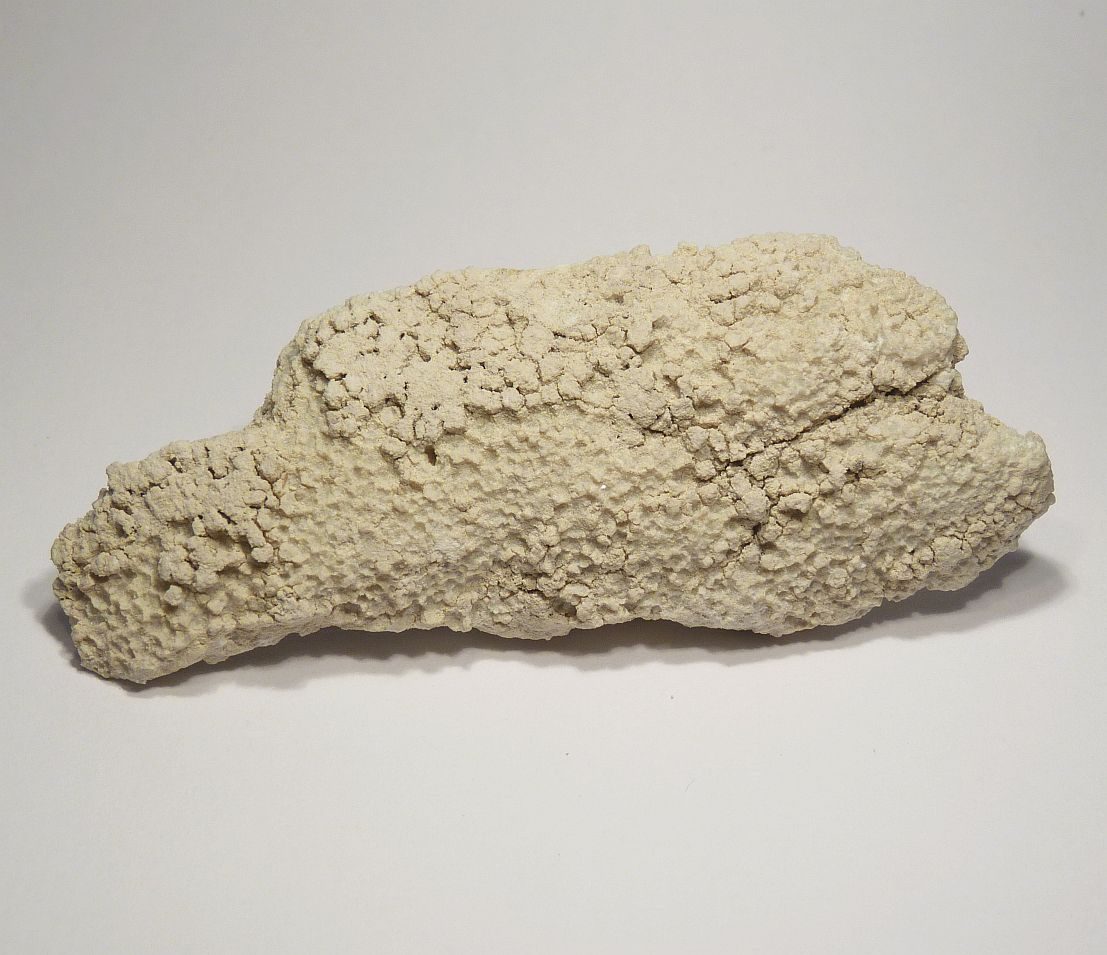
Magadiite. Collected in 1990. From Lake Magadi, Kajiado County, Kenya. — Photo: Leon Hupperichs · CC BY-SA 3.0
Magadiite
A soft white sodium silicate that precipitates from alkaline brines — named for Kenya's Lake Magadi.
Intro adapted from Wikipedia (CC BY-SA).
Magadiite is an IMA-recognized mineral species in the silicate class, with the chemical formula Na₂Si₁₄O₂₉·11H₂O.
It crystallizes in the monoclinic crystal system (space group C2/m).
Key properties: Mohs hardness 2; specific gravity 2.17; refractive index 1.47; optically biaxial.
IMA symbol Mgd, IMA status: approved, named in 1967.
Found in silts of upper Pleistocene to recent age, precipitated by evaporation of saline brines (Lake Magadi); in veins cutting playa sediments and in muds in association with alkali salts and brines (Alkali Lake Playa, Oregon).
It is found associated with Kenyaite, calcite (Lake Magadi); kanemite (Lake Chad); bavenite, pectolite, apophyllite, phlogopite, quartz, thaumasite (Mont Saint-Hilaire); varennesite.
The name refers to the Kenyan locality, Lake Magadi.