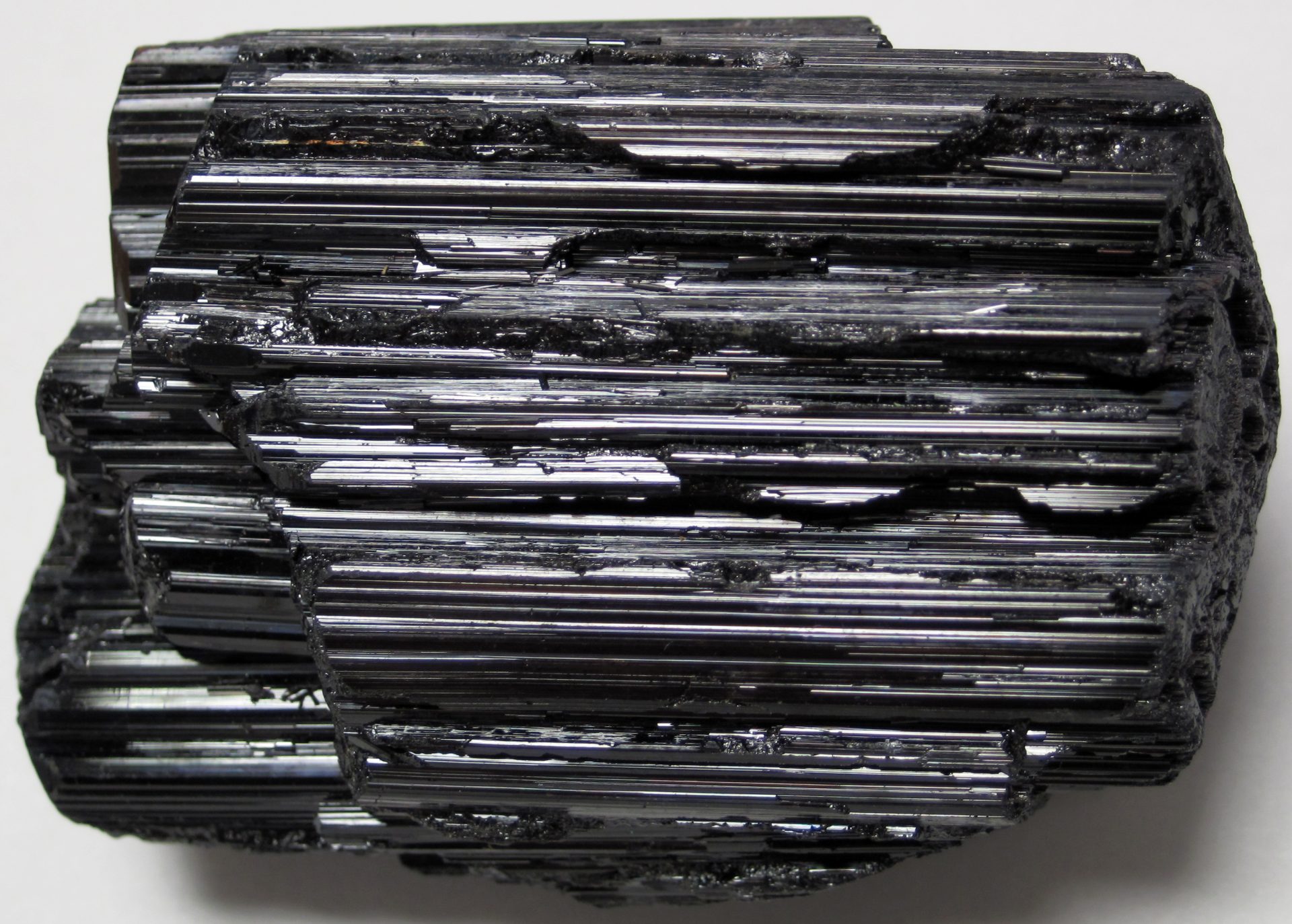
Magnesio-foitite tourmaline from Madagascar. A mineral is a naturally-occurring, solid, inorganic, crystalline substance having a fairly definite chemical composition and having fairly definite physical properties. At its simplest, a mineral is a naturally-occurring solid chemical. Currently, there are over 5500 named and described minerals - about 200 of them are common and about 20 of them are very common. Mineral classification is based on anion chemistry. Major categories of minerals are: elements, sulfides, oxides, halides, carbonates, sulfates, phosphates, and silicates. The silicates are the most abundant and chemically complex group of minerals. All silicates have silica as the basis for their chemistry. "Silica" refers to SiO2 chemistry. The fundamental molecular unit of silica is one small silicon atom surrounded by four large oxygen atoms in the shape of a triangular pyramid - this is the silica tetrahedron - SiO4. Each oxygen atom is shared by two silicon atoms, so only half of the four oxygens "belong" to each silicon. The resulting formula for silica is thus SiO2, not SiO4. Tourmaline is a classic "garbage-can mineral" - it has a little bit of just about everything. Tourmaline can be given the formula (Na,Ca)(Li,Mg,Al)(Fe,Mn,Al)6(BO3)3(Si6O18)(OH,F)4 - sodium calcium lithium magnesium iron manganese hydroxy-fluoro-boro-aluminosilicate. Tourmaline has a nonmetallic luster, varies in color but is often blackish, has a white streak, is quite hard (H = 7 to 7.5), frequently has elongated crystals with rounded triangular cross-sections and striated faces, no cleavage, and conchoidal fracture. Tourmaline is a group of minerals, the most common of which is the blackish-colored, Fe-rich schorl (see elsewhere in this photo album). Dark brown, Mg-rich dravite is another moderately common variety of tourmaline. Other varieties include achroite, elbaite (Li & Na-rich), indicolite, liddicoatite (Li & Ca-rich), rubellite, verdelite, and others. The latter-listed tourmalines are often richly colored (greenish, yellowish, reddish, pinkish, bluish, multicolored). Tourmaline is moderately common in pegmatites and some metamorphic rocks. It can even be rock-forming - see the scarce rock tourmalinite ( www.flickr.com/photos/jsjgeology/15095512541 ). The crystal shown above is a scarce variety of tourmaline called magnesio-foitite (magnesiofoitite) - Na(Mg2Al)Al6(Si6O18)(BO3)3(OH)4 (= sodium magnesium hydroxy-boro-aluminosilicate). This specimen likely comes from a pegmatite. Locality: unrecorded locality attributed to Antananarivo Province, central Madagascar Photo gallery of tourmaline: www.mindat.org/gallery.php?min=4003 — Photo: James St. John · CC BY 2.0
Magnesio-foitite
Magnesio-foitite is an IMA-recognized mineral species in the silicate class, with the chemical formula (Mg₂Al)Al₆(Si₆O₁₈)(BO₃)₃(OH)₃(OH).
It crystallizes in the hexagonal crystal system (space group R3m). It is a member of the Tourmaline structural group.
Key properties: Mohs hardness 7; specific gravity 2.995; optically uniaxial.
IMA symbol Mfoi, IMA status: approved, named in 1998.
From an alteration zone in a silicified porphyry developed in completely altered andesitic to dacitic volcanic rocks (Japan); in unconformity-type uranium deposits (Canada).
It is found associated with Hematite, pyrite, rutile, quartz (Japan); epidote, hematite, quartz, dravitic tourmaline (Canada).
The prefix, magnesio, indicates the magnesium analogue of foitite.