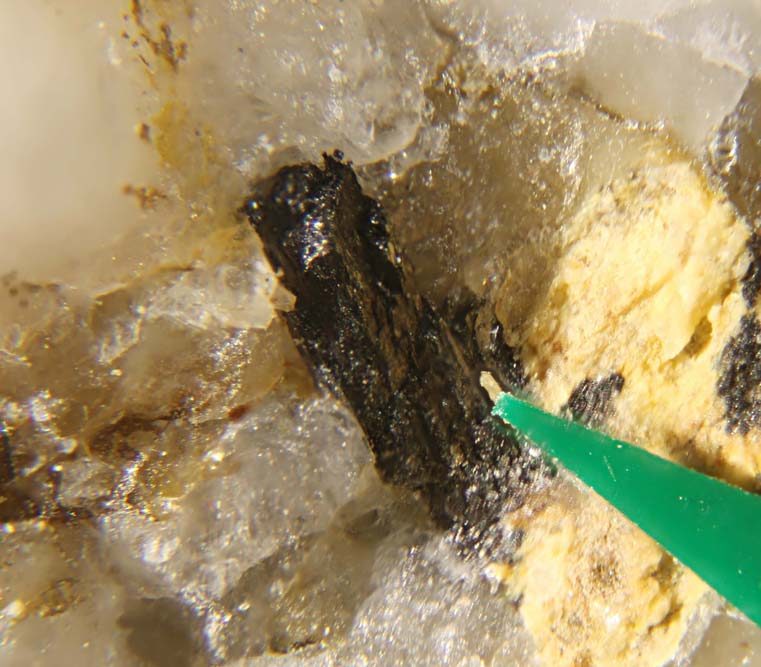
Outstanding black crystal of the Ba-Ti-V mineral mannardite on a contrasting matrix, from the type locality: Rough claims, Kechika River, British Columbia, Canada. — Photo: David Hospital · CC BY-SA 4.0
Mannardite
Mannardite is an IMA-recognized mineral species in the oxides & hydroxide class, with the chemical formula Ba(Ti₆V³⁺₂)O₁₆.
It crystallizes in the tetragonal crystal system (space group I4/m). It is a member of the Coronadite structural group.
Key properties: Mohs hardness 5.5–7; specific gravity 4.12–4.43; White to grayish white streak; Adamantine luster; optically uniaxial.
IMA symbol Man, IMA status: approved, named in 1983.
Found in late-stage quartz-carbonate veins cutting shale and siltstone (Rough claims, Canada); in an orebody in faulted metasediments and iron formation (Bathurst, Canada); in a silver-bearing polymetallic deposit (Kantsi, China).
It is found associated with Barytocalcite, norsethite, sulvanite, barite, quartz (Rough claims, Canada); edingtonite, harmotome, barytocalcite, siderite, sphalerite, quartz (Bathurst.
The mineral was named to honor Dr. George William Mannard (1932–1982), formerly President of Kidd Creek Mines, Ltd., Toronto, Canada, for his interest in the mineral deposits of British Columbia.