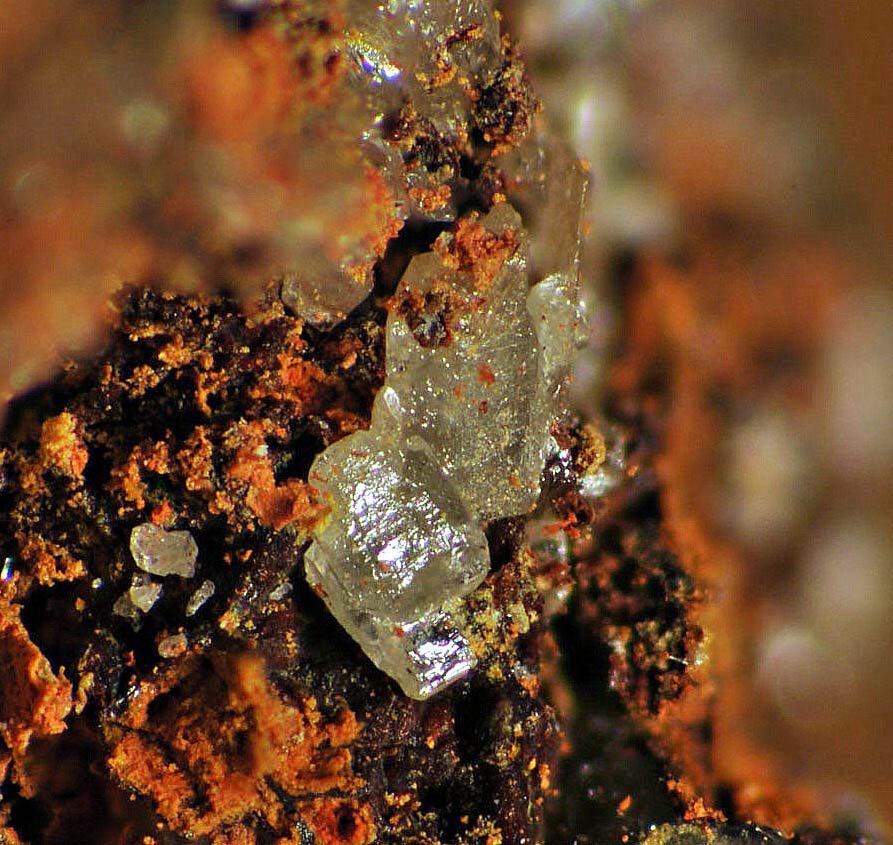
Exceptionally well crystallized specimen of the very rare copper iodide marshite(CuI) from this already famous Russian deposit: Rubtsovskoe Deposit, Altaiskii Krai, Western Siberia, Russian Federation. Marshite occurs as complex beige crystals in a contrasting brown matrix. For an excellent review on the locality see the Mineralogical Record Vol.45, nº4, July-August 2014 article, where it tells that the marshite occurrence inside the mine was only 6 m long ! (p.409). In addition, the Munich Show report in the Mineralogical Record (Vol.46, num 1, 2015, p.168) tells that "all mining of ore has been ceased, this great locality has reached the end of the line". For this reason, future discoveries of marshite is probably unlikely — Photo: David Hospital · CC BY-SA 4.0
Marshite
Natural copper iodide — an isometric halide forming a series with the silver end-member miersite.
Intro adapted from Wikipedia (CC BY-SA).
Marshite is an IMA-recognized mineral species in the halide class, with the chemical formula CuI.
It crystallizes in the cubic crystal system (space group F-43m). It is a member of the Sphalerite structural group.
Key properties: Mohs hardness 2.5; specific gravity 5.59–5.68; Bright to pale yellow streak; Adamantine luster.
IMA symbol Msh, grandfathered status — known before the IMA’s founding, named in 1892.
A rare mineral found in the oxidized zone of a metamorphosed Pb–Zn–Ag deposit (Broken Hill, Australia); in the oxidized zone of a porphyry copper deposit (Chuquicamata, Chile); in tills over a copper anomaly.
It is found associated with Copper, cuprite, cerussite, malachite, Fe–Mn oxides (Broken Hill, Australia); copper, atacamite, tenorite, gypsum (Chuquicamata, Chile).
The name refers to Charles W. Marsh, who first noted the mineral at Broken Hill, Australia.