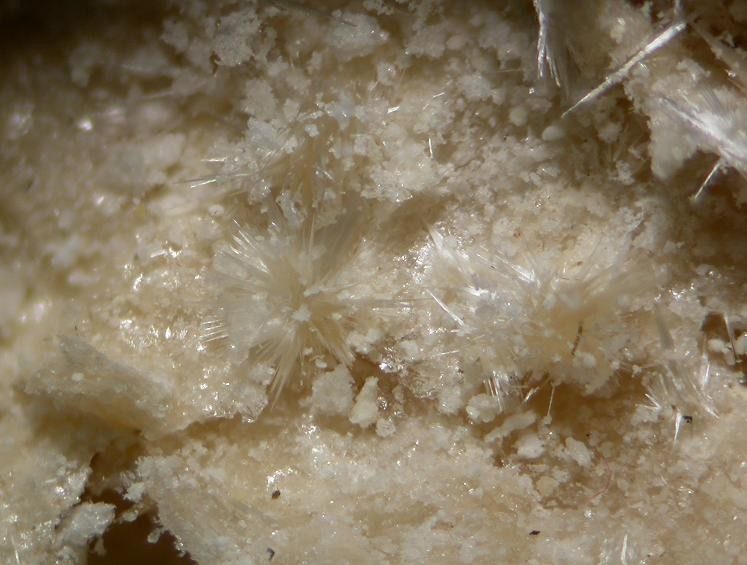
Mascagnite Locality: former Ravat Village, Yagnob River, joint of Zeravshan and Gissar Range, Viloyati Sogd (Viloyati Sughd), Tajikistan ( Locality at mindat.org ) Acicular xls and flakes of Mascagnite. Field of view 6 mm. Specimen and photo Leon Hupperichs. — Photo: Leon Hupperichs · CC BY-SA 3.0
Mascagnite
Natural ammonium sulfate — a soft water-soluble mineral of volcanic fumaroles and burning coal seams.
Intro adapted from Wikipedia (CC BY-SA).
Mascagnite is an IMA-recognized mineral species in the sulfate class, with the chemical formula (NH₄)₂(SO₄).
It crystallizes in the orthorhombic crystal system (space group Pnam). It is a member of the Arcanite structural group.
Key properties: Mohs hardness 2–2.5; specific gravity 1.768; Vitreous to dull luster; optically biaxial.
IMA symbol Msc, grandfathered status — known before the IMA’s founding, named in 1800.
A sublimation product in fumaroles and solfataras; formed by burning coal seams.
It is found associated with Sal ammoniac, tschermigite, sylvite, halite, sassolite, boussingaultite, gypsum, sulfur, cinnabar.
The mineral was named to honor Paolo Mascagni (1755–1815), Professor of Anatomy, University of Siena, Siena, Italy, who provided the original description.