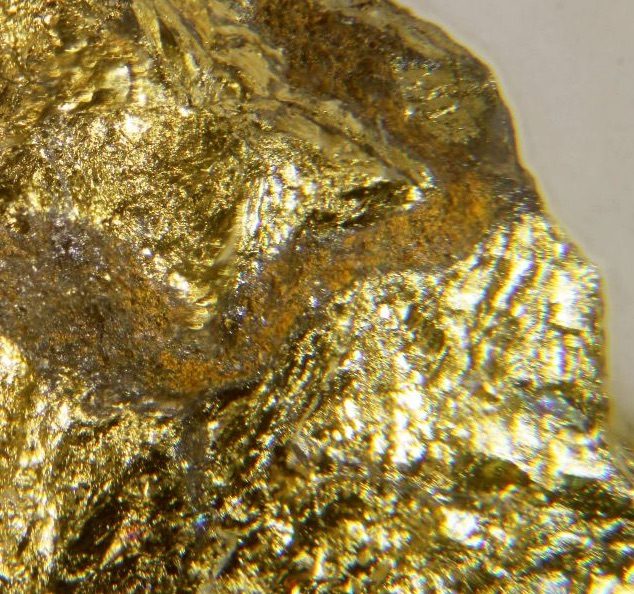
Orange brown veinlet of the very rare Cu-Fe-Sn sulphide mineral mawsonite from the type locality in Tasmania (Mount Lyell Mines, Queenstown, West Coast Municipality, Tasmania, Australia) in a matrix of massive chalcopyrite. Ex Vandenbroucke Museum collection from Waregem, Belgium. — Photo: David Hospital · CC BY-SA 4.0
Mawsonite
A brownish-orange copper-iron-tin sulfosalt named for Antarctic explorer Douglas Mawson.
Intro adapted from Wikipedia (CC BY-SA).
Mawsonite is an IMA-recognized mineral species in the sulfide class, with the chemical formula Cu₆Fe₂SnS₈.
It crystallizes in the tetragonal crystal system (space group P-4m2).
Key properties: Mohs hardness 3.5–4; specific gravity 4.65.
IMA symbol Maw, IMA status: approved, named in 1964.
Found in massive to disseminated hydrothermal copper ores within highly altered volcanic rocks; in skarns; disseminated in altered granites; rare in copper porphyry deposits.
It is found associated with Bornite, pyrite, chalcopyrite, chalcocite, digenite, idaite, stannite, stannoidite, pyrrhotite, pentlandite, tetrahedrite–tennantite, enargite.
The mineral was named to honor Sir Douglas Mawson (1882–1958), noted English-Australian geologist and Antarctic explorer.