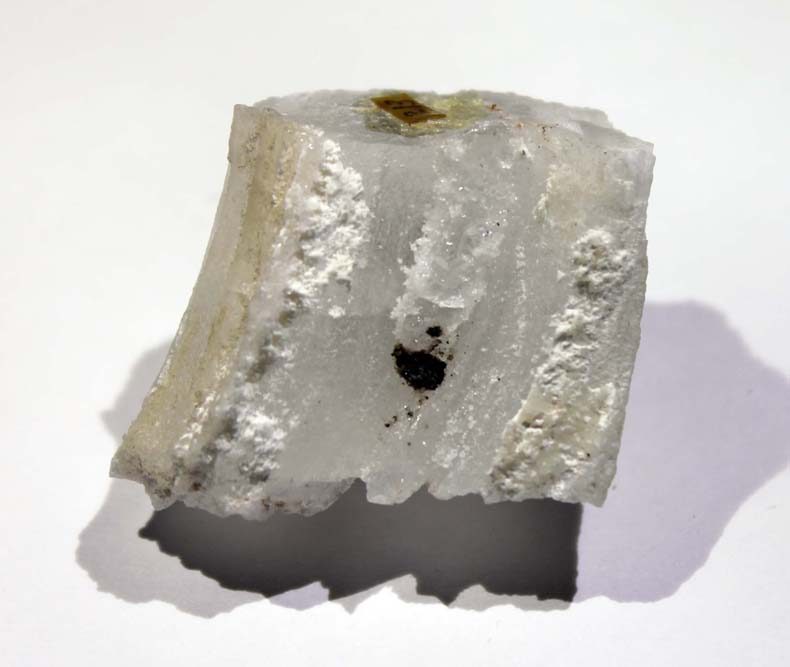
Colorless crystals of the rare Na-Al sulphate mineral mendozite in matrix of the same mineral. Ex.Ralph Merrill collection. From: Mecca Hills, Riverside County, California, United States of America. — Photo: David Hospital · CC BY-SA 4.0
Mendozite
Soda alum — a hydrated sodium-aluminium sulfate discovered in western Argentina in 1868.
Intro adapted from Wikipedia (CC BY-SA).
Mendozite is an IMA-recognized mineral species in the sulfate class, with the chemical formula NaAl(SO₄)₂·11H₂O.
It crystallizes in the monoclinic crystal system (space group C2/c).
Key properties: Mohs hardness 3; specific gravity 1.73; refractive index 1.458; optically biaxial.
IMA symbol Mz, grandfathered status — known before the IMA’s founding, named in 1868.
Rarely produced through oxidation of pyrite in reaction with clays; can occur in volcanic fumaroles.
It is found associated with Tamarugite.
The name refers to its originally described occurrence in Mendoza Province, Argentina.