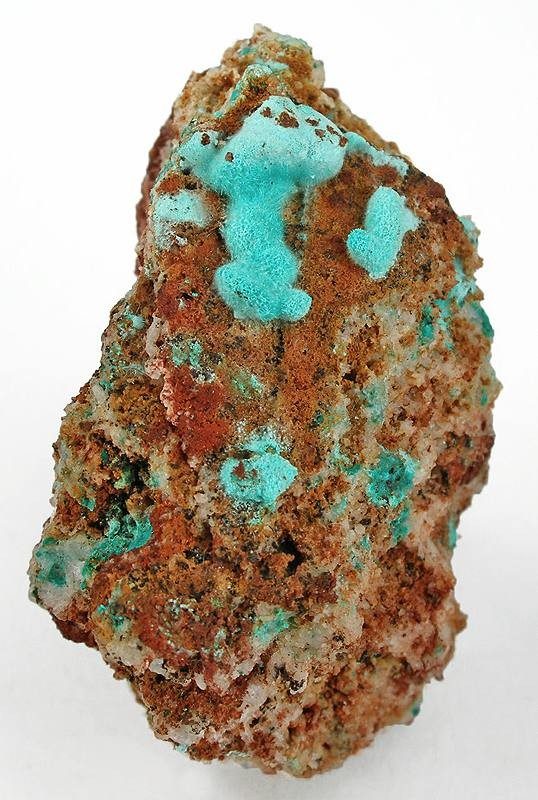
Mixite Locality: Lavrion (Laurion; Laurium) District, Attikí (Attica; Attika) Prefecture, Greece ( Locality at mindat.org ) Size: 6.8 x 5.0 x 3.6 cm. Mixite is a rare bismuth copper arsenate, and from Laurium is not in itself rare...but it is often found only as sparse microcrystalline material on large plates, and seldom as concentrated crystal clusters like you see here. This attractive turquoise-colored cluster of mixite crystals is nearly 2 cm, and winds attractively down the matrix. Unusually rich for this locality, but also for mixite from any other place as well. — Photo: Robert M. Lavinsky · CC BY-SA 3.0
Mixite
A rare blue-green copper-bismuth arsenate forming radiating acicular prisms and crusts.
Intro adapted from Wikipedia (CC BY-SA).
Mixite is an IMA-recognized mineral species in the arsenate class, with the chemical formula Cu₆Bi(AsO₄)₃(OH)₆·3H₂O.
It crystallizes in the hexagonal crystal system (space group P6_3/m). It is a member of the Mixite structural group.
Key properties: Mohs hardness 3–4; specific gravity 3.79–3.83; Pale bluish green streak; Vitreous, silky in aggregates luster; refractive index 1.783; optically uniaxial.
IMA symbol Mix, grandfathered status — known before the IMA’s founding, named in 1880.
Occurs as an uncommon secondary mineral in the oxidized zone of copper deposits.
It is found associated with Bismutite, smaltite, bismuth, atelestite, erythrite, malachite, barite.
The mineral was named to honor Anton Mixa, a mining official from Přı́bram, who found the mineral at Jáchymov, Czech Republic.