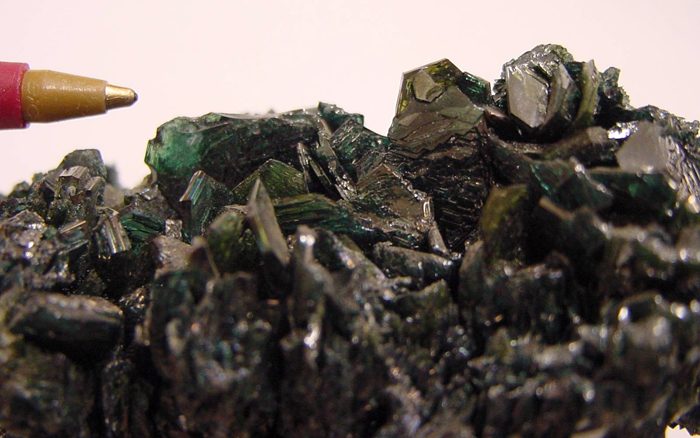
Moissanite (SiC), Mineral collection of Brigham Young University Department of Geology, Provo, Utah. — Photo: Andrew Silver · Public domain
Moissanite
Natural silicon carbide — discovered by Henri Moissan in a meteorite in 1893; today synthesized as a diamond-like gemstone.
Intro adapted from Wikipedia (CC BY-SA).
Moissanite is an IMA-recognized mineral species in the native element class, with the chemical formula SiC.
It crystallizes in the hexagonal crystal system (space group P6_3mc). It is a member of the Wurtzite structural group.
Key properties: Mohs hardness 9.5; specific gravity 3.1–3.29; Metallic to adamantine luster; optically uniaxial.
IMA symbol Moi, grandfathered status — known before the IMA’s founding, named in 1905.
Rare: formed in an iron meteorite; as inclusions in diamond; in diamondiferous kimberlites and lamproites, and in eclogite; in volcanic breccias and rhyolite; in alluvium.
It is found associated with Iron, diamond (Canyon Diablo); quartz, diamond (Fuxian, China); garnet, coesite, clinopyroxene, quartz, rutile, graphite, pyrrhotite.
The name refers to Ferdinand F. Henri Moissan (1852-1907), French chemist, who noted the species in the Canyon Diablo meteorite.