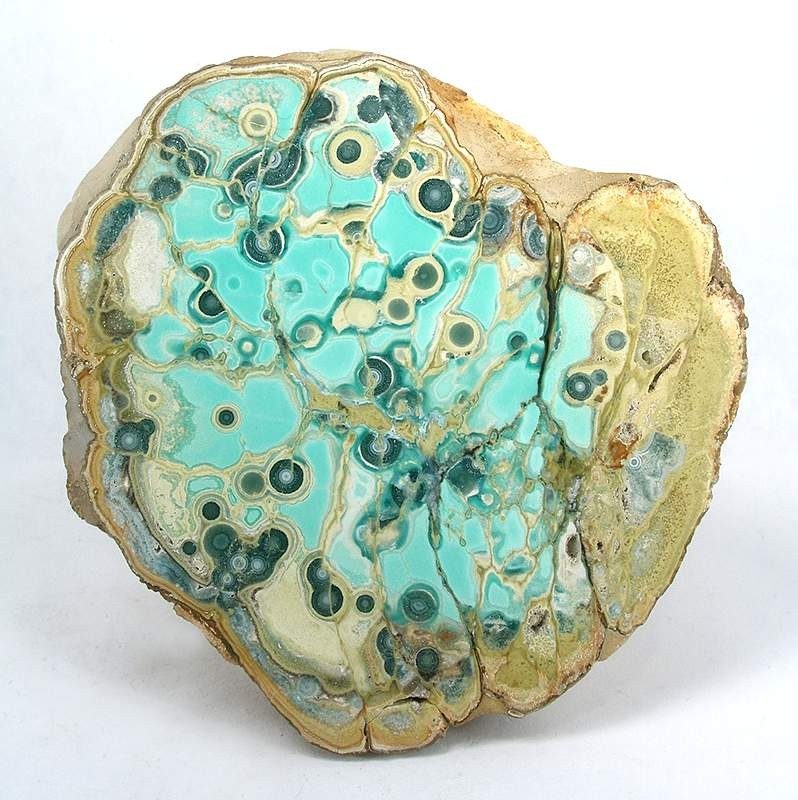
Variscite , Montgomeryite , Crandallite , Wardite Locality: Clay Canyon, Fairfield , Oquirrh Mts, Utah County , Utah , USA ( Locality at mindat.org ) Size: 11.9 x 11.7 x 3.8 cm. This is a large phosphate nodule from this classic locality which is very rich in some of the rare species found mostly in older specimens and not around so much in pieces collected in more recent times. The bright green is the Variscite with a large amount of canary-yellow Crandalite and some gray Wardite present around the green core. The darker green circles are Montgomeryite, for which this is the type locality. Ex. Rice Northwest Museum Collection. — Photo: Robert M. Lavinsky · CC BY-SA 3.0
Montgomeryite
A very rare calcium-magnesium-aluminium phosphate discovered in variscite nodules at Fairfield, Utah.
Intro adapted from Wikipedia (CC BY-SA).
Montgomeryite is an IMA-recognized mineral species in the phosphate class, with the chemical formula Ca₄MgAl₄(PO₄)₆(OH)₄·12H₂O.
It crystallizes in the monoclinic crystal system (space group C2/c). It is a member of the Calcioferrite structural group.
Key properties: Mohs hardness 4; specific gravity 2.53; Vitreous luster; optically biaxial.
IMA symbol Mgm, grandfathered status — known before the IMA’s founding, named in 1940.
Found in sedimentary phosphatic nodules (Fairfield, Utah, USA); a late mineral in highly oxidized phosphate nodules in granite pegmatite (South Dakota, USA).
It is found associated with Variscite, englishite, wardite, gordonite, crandallite (Fairfield, Utah, USA); mitridatite, triphylite, rockbridgeite–frondelite, whitlockite.
The mineral was named to honor Dr. Arthur Montgomery (1909–1999), American mineralogist, Professor of Geology, Lafayette College, Easton, Pennsylvania, USA, who collected the first specimens.