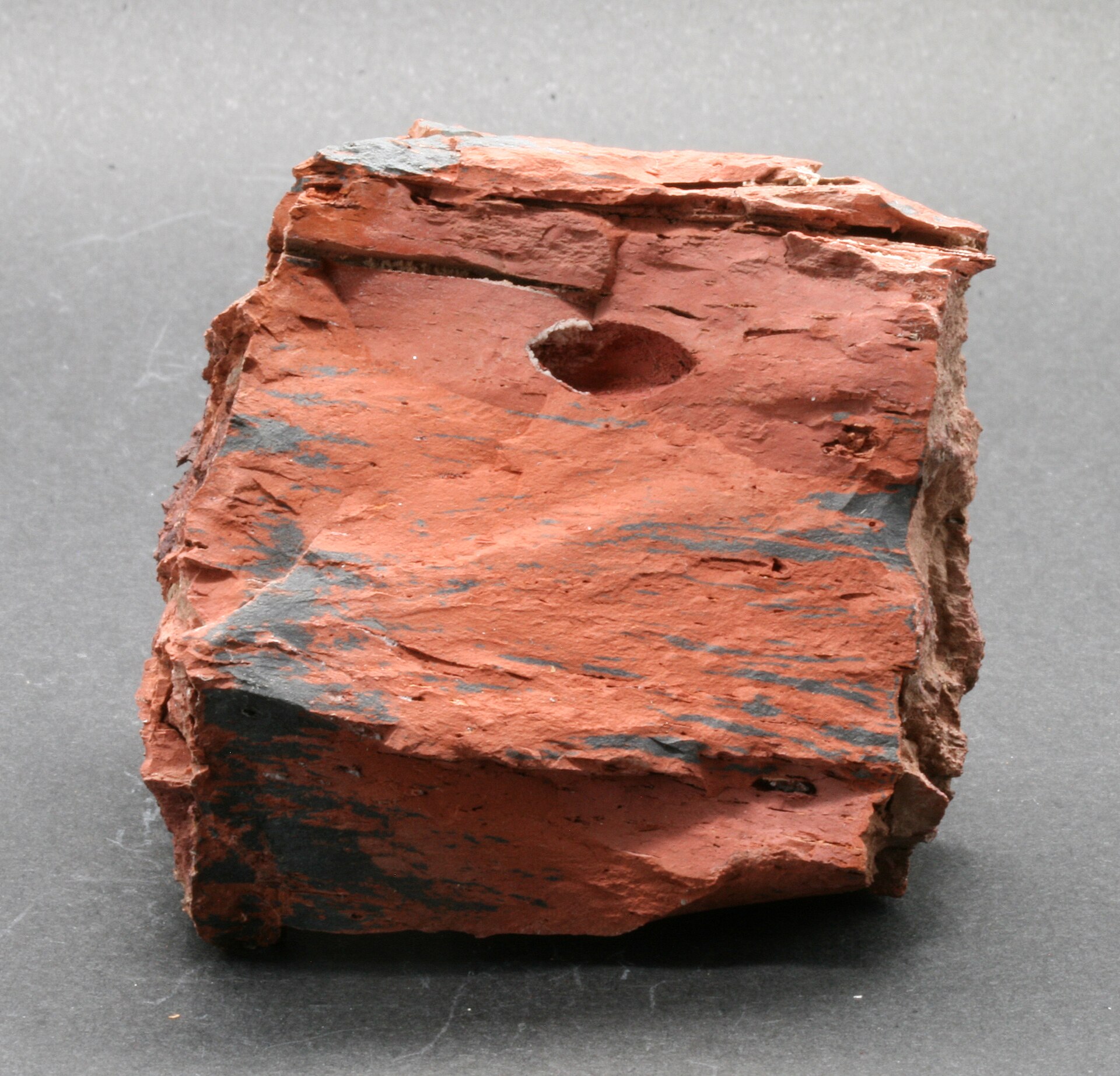
Mullite in porcelanite. Produced by in situ the thermal metamorphism of clays caused by the spontaneous combustion, at an unknown time, of lignite beds intebbe — Photo: Miguel Calvo · CC BY 4.0
Mullite
A rare aluminium silicate formed by intense firing of clay — the main mineral of porcelain and refractory ceramics.
Intro adapted from Wikipedia (CC BY-SA).
Mullite is an IMA-recognized mineral species in the silicate class, with the chemical formula Al₄₊₂ₓSi₂₋₂ₓO₁₀₋ₓ (x ≈ 0.4).
It crystallizes in the orthorhombic crystal system (space group Pbam).
Key properties: Mohs hardness 6–7; specific gravity 3.11–3.26; typically colorless or white or pink or gray; white streak; Vitreous luster; refractive index 1.655; optically biaxial.
IMA symbol Mul, grandfathered status — known before the IMA’s founding, named in 1924.
Found in fused argillaceous inclusions in Tertiary eruptive rocks (Isle of Mull, Scotland); as microscopic inclusions in sillimanite in pelitic inclusions in a tonalite (Val Sissone, Italy).
It is found associated with Corundum (Isle of Mull, Scotland); sillimanite, kyanite (Val Sissone, Italy); corundum, magnetite, spinel, pseudobrookite, sanidine.
The name refers to its type locality on the Isle of Mull, Scotland.
Collections: Rare & Remarkable.