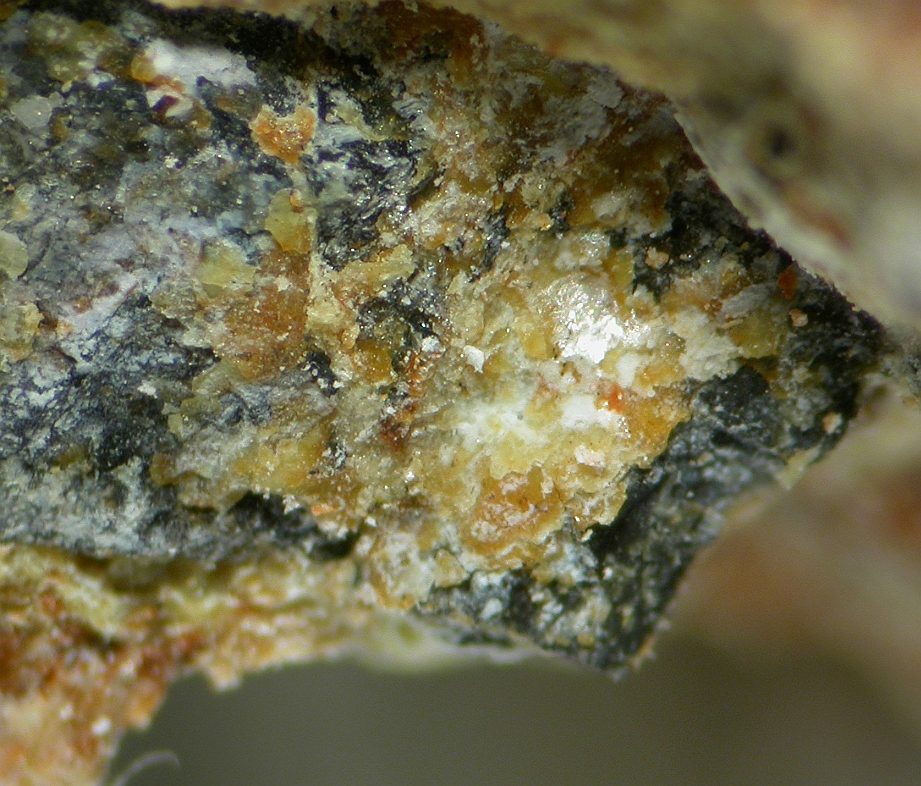
Mundite Locality: Kobokobo pegmatite, Lusungu River District, Sud-Kivu, Democratic Republic of Congo (Zaïre) Yellow to yellowish-orange mundite. Field of view 3 mm — Photo: Leon Hupperichs · CC BY-SA 3.0
Mundite
A yellow-tinged hydrated aluminium-uranium phosphate appearing on sandstone and limestone surfaces.
Intro adapted from Wikipedia (CC BY-SA).
Mundite is an IMA-recognized mineral species in the phosphate class, with the chemical formula Al(UO₂)₃(PO₄)₂(OH)₃·5.5H₂O.
It crystallizes in the orthorhombic crystal system.
Key properties: specific gravity 4.05; Vitreous luster; optically biaxial.
IMA symbol Mud, IMA status: approved, named in 1980.
A rare mineral found in the oxidized uraniferous zone of a complex granite pegmatite.
It is found associated with Phuralumite, upalite, ranunculite, threadgoldite, eylettersite.
The mineral was named to honor Professor Walter Mund (1892–1956), radiochemist, Catholic University of Louvain, Louvain, Belgium.